


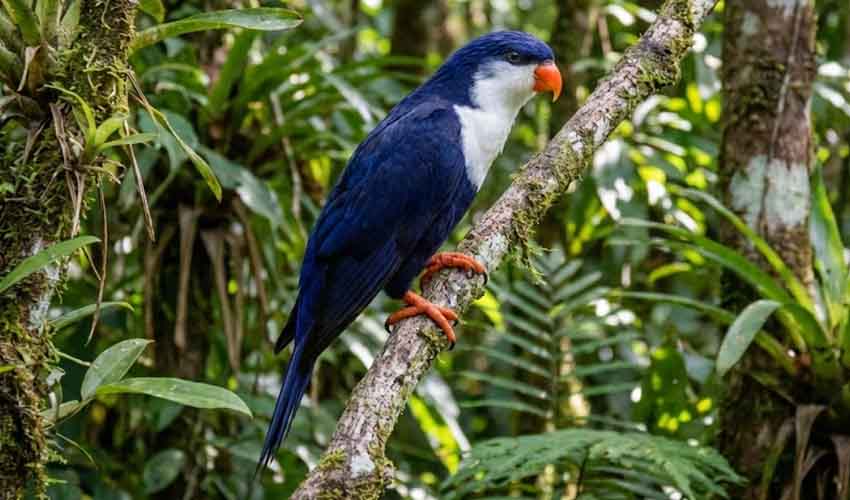
A small, colorful parrot that lives in tropical forests and wooded areas of island regions in the Pacific. It is admired for its striking appearance and lively behavior, making it one of the most eye-catching birds in its habitat. As its name suggests, shades of blue dominate its plumage, often mixed with hints of green, black, and lighter tones depending on the individual and the light. Its compact body, short tail, and quick movements give it an energetic, playful look as it moves through the trees.
Like other lorikeets, it has a brush-like tongue that collects nectar and pollen from flowers. This allows it to feed efficiently on blooming trees, especially in forest canopies. In addition to nectar, it also eats soft fruits and sometimes insects. This diet makes the blue lorikeet an important helper in nature, as it spreads pollen between flowers while feeding, supporting the health of forest plants.
What sets the blue lorikeet apart from many other parrots is its social and active lifestyle. It is often seen in small flocks, flying quickly from tree to tree while calling loudly to one another. These calls help keep the group together and warn of danger. The blue lorikeet is most active during the early morning and late afternoon, when feeding conditions are best. Its strong wings allow it to travel efficiently between feeding areas, even across open spaces between forest patches.
The blue lorikeet also has interesting nesting habits. It usually nests in tree cavities, choosing holes that offer protection from predators and harsh weather. During the breeding season, pairs become more focused and territorial, defending their nesting sites from other birds. The chicks hatch helpless and rely entirely on their parents for warmth and food. Both parents feed the young, regurgitating nectar-rich food until the chicks are strong enough to leave the nest.
Distribution
 Cook Islands
 French Polynesia
Anything we've missed?
Help us improve this page by suggesting edits. Glory never dies!
Suggest an editGet to know me
Terrestrial / Aquatic
Altricial / Precocial
Polygamous / Monogamous
Dimorphic / Monomorphic (size)
Active: Diurnal / Nocturnal
Social behavior: Solitary / Pack / Flock
Diet: Carnivore / Nectarivore / Omnivore / Piscivorous / Insectivore
Migratory: Yes / No
Domesticated: Yes / No
Dangerous: Yes / No




