


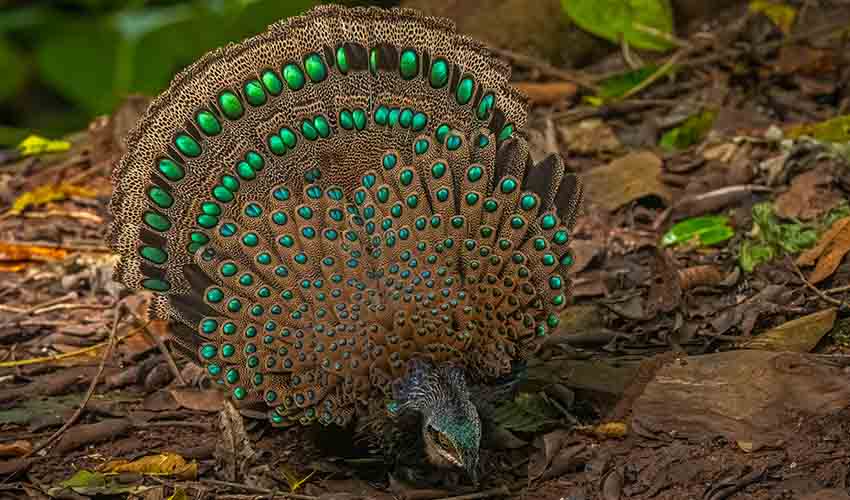
One of the most secretive and mysterious birds of Southeast Asia. It is found only on the island of Borneo, making it a true island specialist. Unlike the bright and famous peacock, this bird is built for subtlety. From a distance, it looks mostly brown and blends almost perfectly with the forest floor. This camouflage helps it stay hidden in dense, shadowy lowland forests. But when seen up close, especially the male, the Bornean peacock-pheasant reveals a very different side—one filled with fine patterns, a neat crest, and striking eye-spots on its tail feathers that can shimmer with hints of blue and green.
What sets the Bornean peacock-pheasant apart from other peacock-pheasants is how rarely it is seen. Even in areas where it is known to live, people often walk through its habitat without ever spotting one. Instead of flying away when disturbed, it usually chooses to run quietly into cover, slipping through undergrowth like a forest shadow. This behavior, combined with its excellent camouflage, makes it extremely hard to observe. It prefers lowland forests, often near rivers and gently sloping terrain, habitats that are unfortunately among the most threatened in Borneo.
In appearance, the male is especially distinctive. He has a slim, upright crest and a long tail decorated with large, glossy eye-spots—each one carefully placed and perfectly shaped. During courtship, he doesn’t make big, noisy movements. Instead, he performs controlled displays, turning and angling his body so the eye-spots line up and catch the light. The effect is subtle but impressive, like a quiet show meant for close viewing. Females are smaller and more plainly colored, which helps them remain hidden while nesting and caring for young.
The Bornean peacock-pheasant spends most of its life on the ground, walking slowly and searching through fallen leaves. Its diet includes seeds, fallen fruit, insects, and other small forest creatures. Rather than rushing, it moves carefully and methodically, fitting its calm personality. At night, it likely roosts off the ground to stay safe. Because it relies so heavily on thick forest cover, any loss of habitat directly impacts its survival, which is why conservation efforts in Borneo are so important for this species.
Distribution
 Indonesia
 Malaysia
Malaysia
MalaysiaAnything we've missed?
Help us improve this page by suggesting edits. Glory never dies!
Suggest an editGet to know me
Terrestrial / Aquatic
Altricial / Precocial
Polygamous / Monogamous
Dimorphic (size) / Monomorphic
Active: Diurnal / Nocturnal
Social behavior: Solitary / Pack / Herd
Diet: Carnivore / Herbivore / Omnivore / Piscivorous / Insectivore
Migratory: Yes / No
Domesticated: Yes / No
Dangerous: Yes / No




