


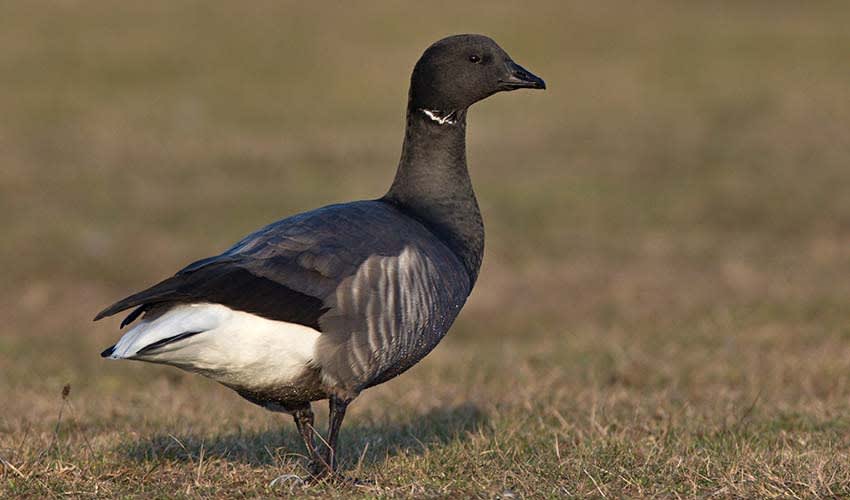
Considerably smaller and more compact than your average Canada goose, the Brant is built like a little tank. Its color palette is moody and sophisticated: a soot-black head, neck, and breast that contrast sharply with a grayish-brown back. But its “signature accessory” is the “necklace”—a delicate, broken ring of white feathers on its neck that looks like a hand-painted collar against its dark plumage.
What truly separates the Brant from almost every other goose is its “ocean-only” lifestyle. While most geese are happy grazing on golf courses or farm fields, the Brant is a saltwater specialist. It spends nearly its entire life along the coast, specifically seeking out intertidal mudflats and shallow bays. It is one of the few birds almost entirely dependent on a very specific food: eelgrass. Because eelgrass grows in the tide, the Brant has to time its meals perfectly, waiting for the water to recede so it can reach the succulent green ribbons. This specialized diet means that if the eelgrass is healthy, the Brant thrives; if it disappears, the Brant is forced to become a pioneer, searching for new coastal frontiers.
Even the way a Brant travels is unique. While most geese fly in high, majestic V-formations, Brants prefer a more “low-key” approach. They usually fly in loose, ragged lines or “bunched” groups, often staying very low over the waves—sometimes so low they seem to be skipping across the water. They are also incredibly quiet compared to their loud, honking cousins. Instead of a trumpet-like blast, they communicate with a soft, guttural “cr-r-r-uk” or a throaty growl. It’s a subtle, almost conversational sound that matches their calm, steady presence on the water.
Distribution
 Algeria
 Austria
 Barbados
 Belarus
 Belgium
 Bermuda
 Bulgaria
 Canada
 China
China Croatia
 Czechia
 Denmark
 Egypt
Egypt Faroe Islands
 Finland
 France
 Germany
 Greece
 Greenland
 Hungary
 Iceland
 Ireland
 Italy
Italy Japan
Japan Kazakhstan
 Korea
Korea Latvia
 Luxembourg
 Mexico
 Morocco
 Netherlands
 North Korea
 Norway
 Poland
 Portugal
 Puerto Rico
 Romania
 Russia
 Saint Pierre
 Senegal
 Slovakia
 Spain
Svalbard
Spain
Svalbard Switzerland
 Taiwan
 Tunisia
 Turkey
 United Kingdom
 United States
Anything we've missed?
Help us improve this page by suggesting edits. Glory never dies!
Suggest an editGet to know me
Terrestrial / Aquatic
Altricial / Precocial
Polygamous / Monogamous
Dimorphic (size) / Monomorphic
Active: Diurnal / Nocturnal
Social behavior: Solitary / Pack / Flock
Diet: Carnivore / Herbivore / Omnivore / Piscivorous / Insectivore
Migratory: Yes / No
Domesticated: Yes / No
Dangerous: Yes / No




