


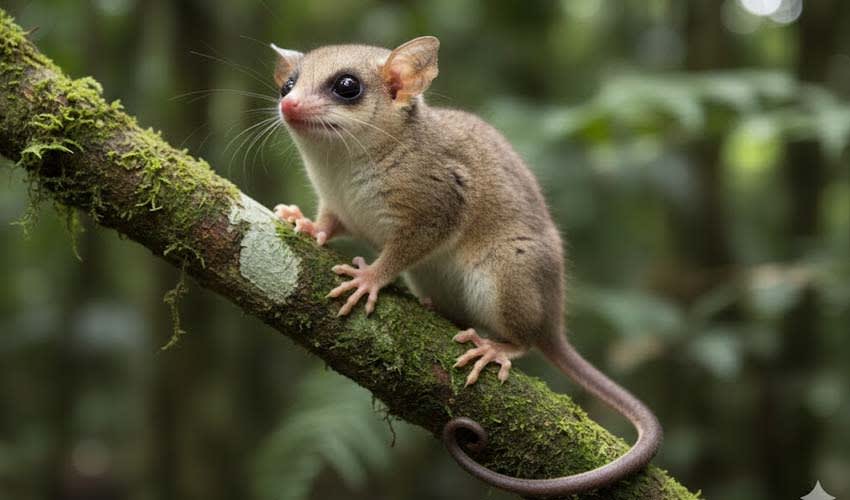
A small, quick, night-active marsupial that feels like it was built for moving through the “in-between spaces” of a forest—thin branches, vine tangles, and leafy understory where bigger animals would clumsily crash through. It has a slim body, a narrow face with a pointed snout, and large dark eyes that make it look permanently curious. Its fur is usually a muted mix of gray-brown or brown on top with paler fur below, a color combo that helps it blend into bark, dry leaves, and shadow. The tail is long, mostly hairless, and very flexible, acting like a balancing line as it creeps along narrow supports.
When most people hear “opossum,” they picture a larger, tougher-looking scavenger that rummages around on the ground. Slender opossums are different: they’re smaller, lighter, and often more tied to forest structure, using shrubs and low-to-mid levels of trees like their main highways. The “Brazilian” part matters too, because it points to a strong connection with Brazilian forests—especially the lush, layered habitats where climbing skill and stealth are more useful than speed across open ground. Compared with heavier opossums that can barrel through leaf litter, this one is more likely to slip quietly through vegetation, pause to listen, then continue with a smooth, controlled climb.
The Brazilian slender opossum often searches for food after sunset, using smell and hearing to track tiny movements in leaves. Insects and other small prey are common targets, but it can also take fruit or other easy forest snacks when it finds them—being flexible is a huge advantage in a habitat where the menu changes with season and weather. It tends to move in a pattern that looks almost strategic: a few careful steps, a pause to sniff, a brief scan, then another quiet advance. If startled, it may freeze rather than bolt, trusting its camouflage and stillness.
Distribution
 Brazil
Anything we've missed?
Help us improve this page by suggesting edits. Glory never dies!
Suggest an editGet to know me
Terrestrial / Aquatic
Altricial / Precocial
Polygamous / Monogamous
Dimorphic (size) / Monomorphic
Active: Diurnal / Nocturnal
Social behavior: Solitary / Pack / Herd
Diet: Carnivore / Herbivore / Omnivore / Piscivorous / Insectivore
Migratory: Yes / No
Domesticated: Yes / No
Dangerous: Yes / No




