


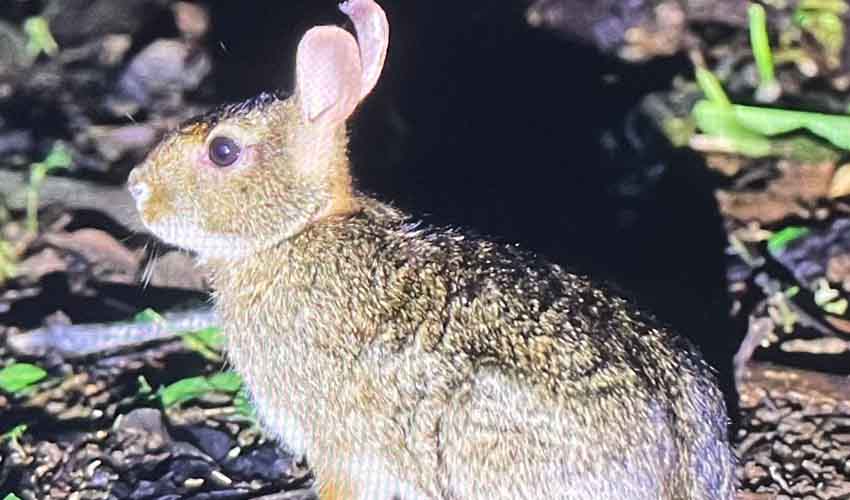
A small, forest-loving rabbit that looks like it was designed for shadows and leaf litter rather than sunny fields. Its coat is typically dark—often blackish-brown along the back—with paler sides and a lighter underside that can look clean and bright when it darts through dim undergrowth. One of its most noticeable quirks is how “compact” it seems: short ears, short hind feet, and an extremely short tail that stays mostly brown rather than flashing a big white “cotton” signal. That darker, quieter look helps it melt into wet forests, thickets, and dense vegetation from southern Mexico through much of Central America, where it spends a lot of time hugging cover and slipping along the edges of streams, shrubs, and tangled roots.
What really distinguishes the Central American tapeti from many other cottontails is its lifestyle and “stealth style.” Plenty of rabbits thrive in open country—pastures, lawns, farm edges—where speed and long, bounding runs matter most. The Central American tapeti is more of a woodland specialist, built for quick, low-speed movement through dense vegetation. Its short ears and tail don’t snag as easily when it threads through vines and brush, and its dark coat doesn’t stand out like the paler, more field-friendly rabbits you might spot in open places. It’s also one of those animals you’re more likely to sense than see: a sudden rustle, a blur close to the ground, and then stillness.
It’s also important to know that the “tapeti” found across the Americas isn’t just one kind of rabbit. For a long time, Central American tapetis were grouped with the common tapeti, but close study of their appearance and genetics showed that the Central American tapeti is different enough to be its own species. This helps explain why it seems so different from tapetis farther south: it has its own local patterns and is adapted to the forests and climate of Central America.
Distribution
 Belize
 Costa Rica
 Guatemala
 Mexico
 Nicaragua
 Panama
Anything we've missed?
Help us improve this page by suggesting edits. Glory never dies!
Suggest an editGet to know me
Terrestrial / Aquatic
Altricial / Precocial
Polygamous / Monogamous
Dimorphic (size) / Monomorphic
Active: Diurnal / Nocturnal
Social behavior: Solitary / Pack / Herd
Diet: Carnivore / Herbivore / Omnivore / Piscivorous / Insectivore
Migratory: Yes / No
Domesticated: Yes / No
Dangerous: Yes / No




