


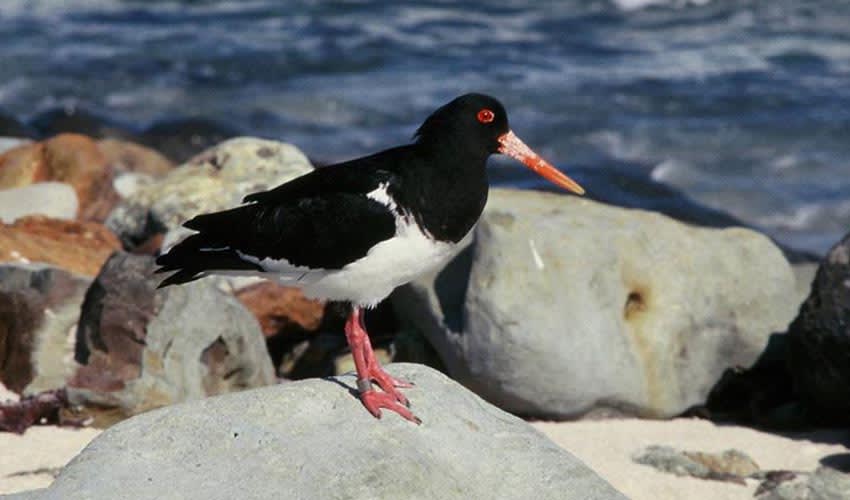
This bold, striking bird lives its entire life on these scattered islands, braving strong winds, powerful surf, and rugged coastlines. It looks like a classic oystercatcher—black above, white below, with a vivid orange-red bill, red eyes, and pinkish legs—but it is noticeably chunkier and more heavy-set than many of its mainland relatives. Its long, chisel-like bill is perfectly built for dealing with tough shellfish, and its bright colours stand out strongly against the pale rocks and surf.
These oystercatchers tend to live on rocky shores with wide reef platforms, where the tide exposes beds of limpets, mussels, and snails. Some pairs choose sandy or gravelly beaches instead, especially where scattered seaweed and stones hide plenty of small invertebrates. They feed by prising open or hammering at shellfish, stabbing at worms, and pulling small creatures from cracks between rocks. Because food on rocky reefs is patchy and slow to replenish, each breeding pair defends its own stretch of coastline. This makes them strongly territorial, with each family maintaining a year-round “address” on the shore.
Their nesting habits are simple but risky. The pair usually scrapes out a shallow hollow on the upper beach or among low vegetation just above the reach of high tide. Sometimes they decorate the scrape with bits of shell or gravel, but most nests remain extremely minimal. The eggs, usually two or three, are sandy and speckled—ideal camouflage against the beach substrate. Both adults share incubation, swapping roles with a sharp whistle or chirping call. When the chicks hatch, they leave the nest area almost immediately, following their parents to safe feeding spots. Although they can walk soon after hatching, they cannot fly for several weeks, and they rely heavily on their parents’ vigilance to stay alive.
Distribution
 New Zealand
 Official estimate
Anything we've missed?
Help us improve this page by suggesting edits. Glory never dies!
Suggest an editGet to know me
Terrestrial / Aquatic
Altricial / Precocial
Polygamous / Monogamous
Dimorphic (size) / Monomorphic
Active: Diurnal / Nocturnal
Social behavior: Solitary / Pack / Herd
Diet: Carnivore / Herbivore / Omnivore / Piscivorous / Insectivore
Migratory: Yes / No
Domesticated: Yes / No
Dangerous: Yes / No




