


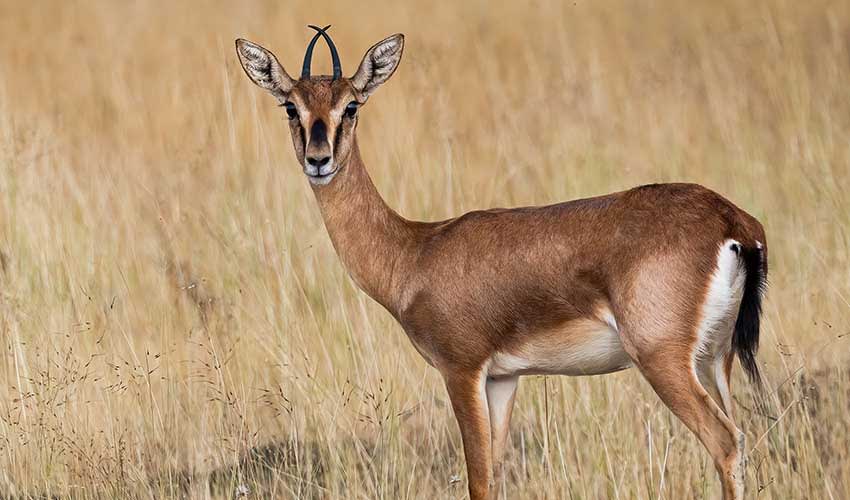
A slender, elegant antelope perfectly shaped for life in dry and open landscapes. It has a light, graceful body, long thin legs, and a narrow head with large, dark eyes that seem constantly alert. Its coat is usually sandy to light brown, blending smoothly with grasslands and scrubby terrain, while the underside is bright white. A distinct dark stripe often runs along the side, giving a sharp outline to its form. Males carry slim, gently curved horns, while females are usually hornless or have much smaller ones.
What sets the chinkara apart from many other gazelles is its strong connection to the dry regions of South Asia. It is widely found across India and into parts of Pakistan, living in deserts, semi-deserts, open plains, and scrub forests. Compared with African gazelles, the chinkara is generally smaller and more lightly built, giving it an especially delicate appearance. It is also more adapted to areas with extreme heat and limited water. Like several desert antelopes, it can go long periods without drinking, obtaining much of the moisture it needs from the plants it eats. This ability allows it to live in places where surface water may be rare or seasonal.
In daily life, the chinkara is a cautious and observant feeder. It eats grasses, leaves, shoots, and herbs, often choosing tender growth that offers both nutrition and moisture. To avoid the worst heat, it is usually most active in the early morning and late afternoon, sometimes even at night in very hot conditions. Socially, chinkaras are often seen alone or in small groups, and they rely heavily on their sharp senses to detect danger. When threatened, they respond with sudden bursts of speed, running in long, smooth strides and sharp turns that can quickly put distance between them and a predator.
Distribution
 Afghanistan
 India
India Iran
Iran Pakistan
Anything we've missed?
Help us improve this page by suggesting edits. Glory never dies!
Suggest an editGet to know me
Terrestrial / Aquatic
Altricial / Precocial
Polygamous / Monogamous
Dimorphic (size) / Monomorphic
Active: Diurnal / Nocturnal
Social behavior: Solitary / Pack / Herd
Diet: Carnivore / Herbivore / Omnivore / Piscivorous / Insectivore
Migratory: Yes / No
Domesticated: Yes / No
Dangerous: Yes / No




