


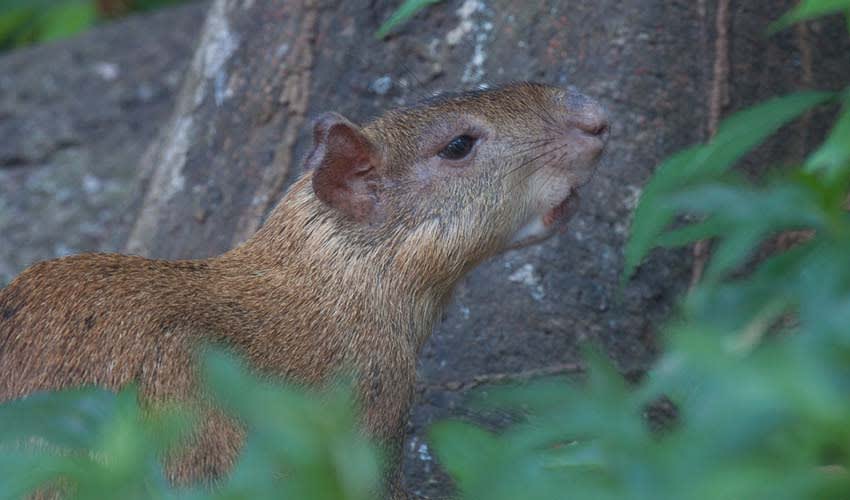
One of Panama’s most unique and little-known mammals, found only on Coiba Island, a large, isolated island off the country’s Pacific coast. This medium-sized rodent looks somewhat like a sleek, long-legged guinea pig, with a slender face, rounded ears, and a short, barely visible tail. Its coat is usually a mix of dark brown and reddish shades, helping it blend into the forest floor. Because the species is restricted entirely to the island, it has evolved subtle differences from its mainland relatives, making the Coiban agouti a fascinating example of island adaptation and biodiversity.
Life on an island has shaped the Coiban agouti in several remarkable ways. Coiba Island was once connected to the mainland but became isolated thousands of years ago, giving its wildlife a long period of independent evolution. As a result, the Coiban agouti is slightly smaller and more delicate-looking than some mainland agoutis. It moves with quiet, quick steps, and its long limbs allow it to dart through undergrowth with surprising speed. Agoutis are known for being alert, nervous animals, and the Coiban variety is no exception—its survival depends on staying aware of predators like snakes, raptors, and introduced species that may roam the island.
The Coiban agouti plays an important ecological role as one of the island’s key seed dispersers. It feeds mainly on fruits, nuts, seeds, and tender vegetation, using its strong teeth to crack open hard shells that many other animals cannot access. One of its signature behaviors is burying seeds in small caches, a habit that provides it with backup food supplies but also helps new plants grow. Because it forgets some of its buried treasures, the agouti ends up planting seeds all over the forest. This makes the species a vital partner in keeping Coiba Island’s forest healthy and diverse.
Distribution
 Panama
Anything we've missed?
Help us improve this page by suggesting edits. Glory never dies!
Suggest an editGet to know me
Terrestrial / Aquatic
Altricial / Precocial
Polygamous / Monogamous
Dimorphic (size) / Monomorphic
Active: Diurnal / Nocturnal
Social behavior: Solitary / Pack / Herd
Diet: Carnivore / Herbivore / Omnivore / Piscivorous / Insectivore
Migratory: Yes / No
Domesticated: Yes / No
Dangerous: Yes / No




