


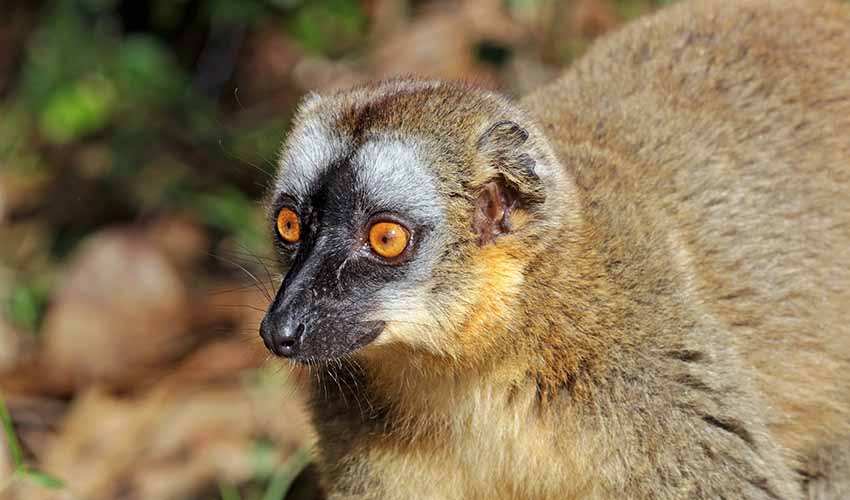
A medium-sized lemur with a classic “forest mammal” look: long tail, alert face, and soft, dense fur in warm shades of brown. It lives mainly in Madagascar, especially in the north and northwest, in dry forests, rainforests, and even some degraded areas—anywhere there are enough trees to climb and food to find. Its coat is usually gray-brown to reddish-brown on the body with a lighter belly, and the tail is long, thick, and fully furred, great for balance when leaping between branches. The face is darker, often grey or blackish, with pale or whitish eyebrows and cheeks that give it a slightly masked expression. Males and females look fairly similar compared with many other lemurs, though males can be a bit darker and may have a richer, more “washed” tone to the fur.
Common brown lemurs are very social. They live in mixed groups that can range from a handful of individuals up to 15 or more, usually including several adults of both sexes plus their young. Unlike some primates with very clear “one male boss,” brown lemur groups tend to have a more balanced social structure; both males and females play important roles in moving, feeding, and keeping an eye out for danger.
Their daily life is built around foraging and travel. Common brown lemurs are mostly active during the day (diurnal), with peaks of activity in the morning and late afternoon when it’s cooler. They’re excellent climbers and leapers, moving quadrupedally along branches and making agile jumps between trees. Their diet is mainly fruit—figs and other fleshy fruits are big favorites—but they also eat leaves, flowers, and now and then bark or invertebrates when fruit is scarce.
Distribution
 Madagascar
 Mayotte
Anything we've missed?
Help us improve this page by suggesting edits. Glory never dies!
Suggest an editGet to know me
Terrestrial / Aquatic
Altricial / Precocial
Polygamous / Monogamous
Dimorphic (size) / Monomorphic
Active: Diurnal / Nocturnal
Social behavior: Solitary / Pack / Troop
Diet: Carnivore / Frugivore / Omnivore / Piscivorous / Insectivore
Migratory: Yes / No
Domesticated: Yes / No
Dangerous: Yes / No




