


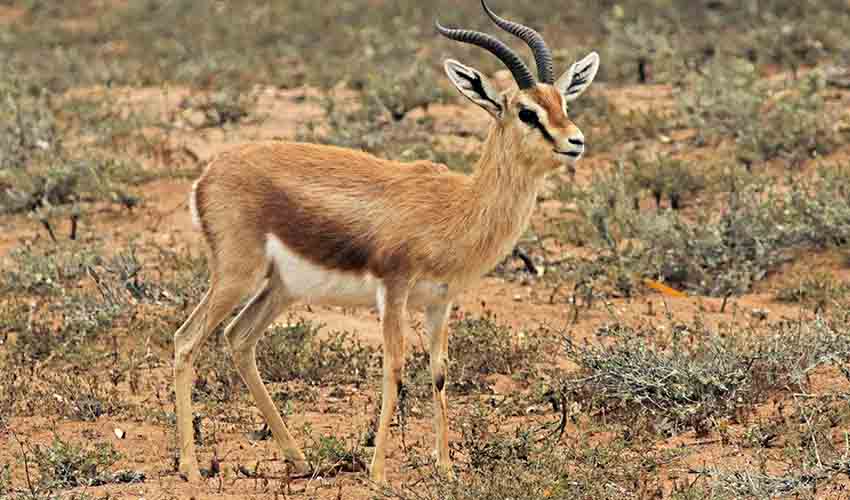
One of the most graceful and light-footed antelopes of the desert, built for a life where heat, sand, and open horizons shape every movement. It has a slim body, long, delicate legs, and a small, finely shaped head with large, dark eyes that always seem alert. Its coat is usually sandy to pale fawn, blending smoothly with desert ground, while the belly is bright white. A narrow dark stripe often runs along the side, adding contrast to its otherwise soft coloring. Both males and females usually carry slender, gently curved horns, though the male’s are typically thicker and longer.
While some gazelles prefer grassy plains, the Dorcas gazelle is a master of arid regions across North Africa and parts of the Middle East. It is generally smaller and lighter than several other gazelle species, which helps it move easily over sandy and rocky terrain. Compared with the Arabian gazelle, it often has a slightly more contrasted side stripe and a somewhat more delicate build. Its body seems tuned for efficiency: minimal weight, long limbs, and a frame that allows quick acceleration and sharp turns when danger appears.
In daily life, the Dorcas gazelle is a cautious and flexible feeder. It eats grasses, leaves, shoots, and desert plants, often selecting young, tender growth that provides both nutrients and moisture. Like many desert animals, it adjusts its activity to avoid extreme heat, feeding and traveling mainly in the early morning, late afternoon, or at night. It can live for long periods without direct access to water, drawing much of the moisture it needs from its food. Socially, Dorcas gazelles may be seen alone, in pairs, or in small groups, and they maintain alert spacing so that at least one individual is always watching while others feed.
Distribution
 Algeria
 Burkina Faso
 Chad
Chad Djibouti
 Egypt
Egypt Official estimate
 Eritrea
 Ethiopia
 Israel
Official estimate
Israel
Official estimate
 Jordan
 Libya
Libya Mali
Mali Mauritania
 Morocco
 Niger
Niger Nigeria
 Senegal
 Somalia
 Sudan
Sudan Tunisia
Anything we've missed?
Help us improve this page by suggesting edits. Glory never dies!
Suggest an editGet to know me
Terrestrial / Aquatic
Altricial / Precocial
Polygamous / Monogamous
Dimorphic (size) / Monomorphic
Active: Diurnal / Nocturnal
Social behavior: Solitary / Pack / Herd
Diet: Carnivore / Herbivore / Omnivore / Piscivorous / Insectivore
Migratory: Yes / No
Domesticated: Yes / No
Dangerous: Yes / No




