


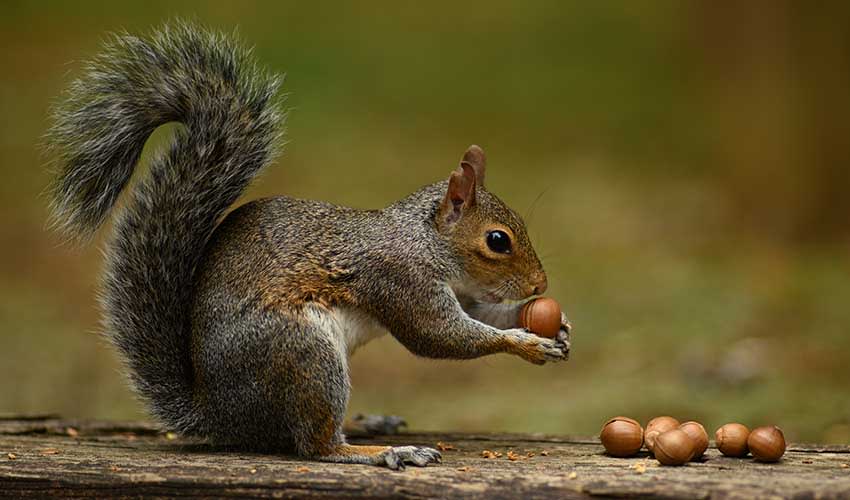
One of the most familiar tree squirrels in North America, often seen racing across lawns, climbing trees, or sitting upright while holding food in its front paws. It usually has gray fur, a pale belly, bright dark eyes, and a large bushy tail edged with lighter hairs. Even though it may look ordinary because it is so common in many towns and parks, it is actually a very successful and clever animal.
One thing that makes the Eastern gray squirrel stand out is its amazing memory for hidden food. In autumn, it buries nuts such as acorns, walnuts, and hickory nuts in many different places. This habit is called scatter-hoarding, but in simple words, it means hiding snacks all over the neighborhood. It does not find every buried nut again, and those forgotten nuts can grow into new trees. This makes the Eastern gray squirrel an accidental forest planter. Its habit of storing food helps it survive winter, but it also helps forests renew themselves.
The Eastern gray squirrel is also famous for its quick thinking and problem-solving. It can figure out bird feeders, open weak containers, cross fences, and leap between branches with impressive accuracy. Its tail is more than decoration: it helps with balance, keeps the squirrel warm, provides shade, and can signal danger or excitement. When alarmed, it may flick its tail rapidly and make sharp warning sounds. It can also rotate its ankles in a way that helps it climb down tree trunks headfirst, which many animals cannot do easily.
Distribution
 Canada
 Ireland
 Italy
Italy South Africa
 United Kingdom
 United States
Anything we've missed?
Help us improve this page by suggesting edits. Glory never dies!
Suggest an editGet to know me
Terrestrial / Aquatic
Altricial / Precocial
Polygamous / Monogamous
Dimorphic (size) / Monomorphic
Active: Diurnal / Nocturnal
Social behavior: Solitary / Pack / Herd
Diet: Carnivore / Herbivore / Omnivore / Piscivorous / Insectivore
Migratory: Yes / No
Domesticated: Yes / No
Dangerous: Yes / No




