


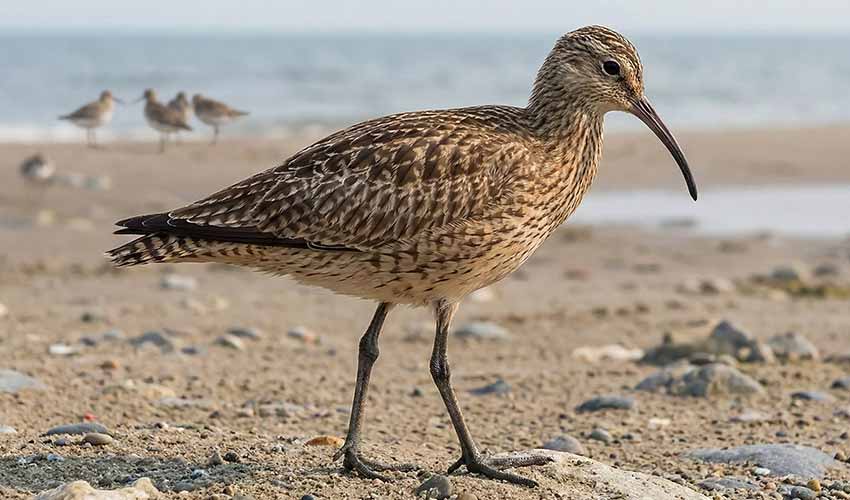
General full One of the saddest legends in bird history: a small, mottled shorebird that went from sky-darkening flocks to near-certain extinction in barely a human lifetime. About pigeon-sized, it had warm brown upperparts finely speckled with buff, a streaked breast, and a long, thin, slightly down-curved bill. It looked very similar to a small whimbrel but could be told by its plain (unbarred) underwings and a narrower, less bold central crown stripe.
The Eskimo curlew bred on the Arctic tundra of western Canada and probably parts of Alaska and Nunavut, nesting in open upland tundra with dwarf shrubs and grassy meadows. Only a couple of breeding areas were ever firmly documented, both in what’s now the Northwest Territories, and there has been no confirmed nesting since 1866. Its annual journey traced an enormous loop through the Americas. After breeding, huge flocks moved southeast across the Canadian Prairies and Great Plains of the United States, where they stopped to gorge on insects—especially the once-astonishing swarms of Rocky Mountain locusts.
At one time, Eskimo curlews were immensely numerous. Early accounts describe flocks “in the millions,” likened to the now-extinct passenger pigeon. But in the late 1800s, they were hammered by unregulated market hunting. As they moved through the Great Plains and up the Atlantic coast during migration, hunters shot them by the wagonload; one estimate suggests up to two million birds a year were killed near the end of the 19th century. At the same time, prairie and pampas grasslands were rapidly converted to agriculture, and the Rocky Mountain locust itself went extinct, removing a key food source during spring migration. By the early 1900s, the curlew had almost vanished. Hunting was finally banned under the 1916 Migratory Bird Treaty, but by then the population was already so depleted that no recovery followed.
Distribution
 Argentina
 Barbados
 Bermuda
 Official estimate
 Bolivia
 Brazil
 Canada
 Chile
Chile Falkland Islands
Official estimate
Falkland Islands
Official estimate
 Greenland
Official estimate
Greenland
Official estimate
 Grenada
Official estimate
Grenada
Official estimate
 Guadeloupe
Official estimate
Guadeloupe
Official estimate
 Guatemala
Official estimate
Guatemala
Official estimate
 Iceland
Official estimate
Iceland
Official estimate
 Ireland
Official estimate
Ireland
Official estimate
 Mexico
 Paraguay
 Puerto Rico
Official estimate
Puerto Rico
Official estimate
 Russia
Official estimate
Russia
Official estimate
 Saint Vincent
Official estimate
Saint Vincent
Official estimate
 Trinidad & Tobago
 US Virgin Islands
Official estimate
US Virgin Islands
Official estimate
 United Kingdom
Official estimate
United Kingdom
Official estimate
 United States
 Uruguay
Anything we've missed?
Help us improve this page by suggesting edits. Glory never dies!
Suggest an editGet to know me
Terrestrial / Aquatic
Altricial / Precocial
Polygamous / Monogamous
Dimorphic (size) / Monomorphic
Active: Diurnal / Nocturnal
Social behavior: Solitary / Pack / Herd
Diet: Carnivore / Herbivore / Omnivore / Piscivorous / Insectivore
Migratory: Yes / No
Domesticated: Yes / No
Dangerous: Yes / No




