


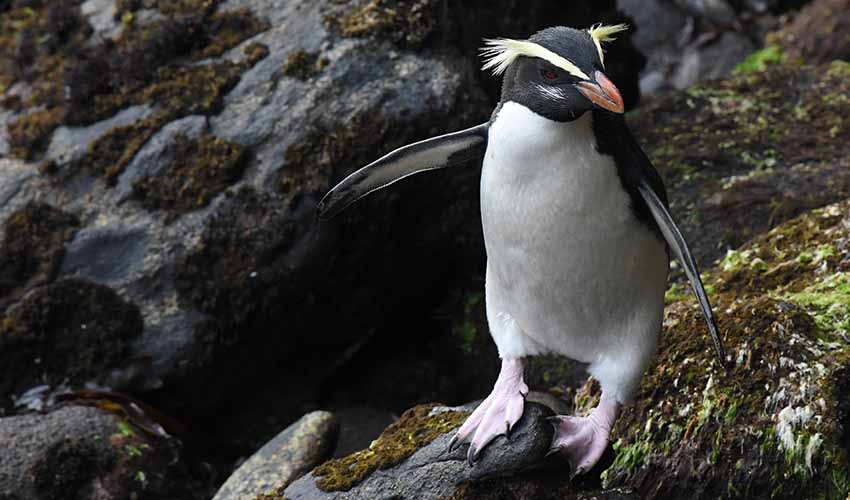
One of the most mysterious and shy penguins in the world, living in the remote, rain-soaked forests and rocky coastlines of New Zealand’s South Island. Also known as the tawaki, this penguin stands out immediately because of its striking appearance. It has dark blue-black feathers on its back, a white belly, and most notably, bold yellow stripes that run from above its eyes down the sides of its head. These bright markings give it a dramatic, almost expressive look that sets it apart from other penguin species. Unlike many penguins that gather in large, noisy colonies on open beaches, Fiordland penguins prefer quiet, hidden places surrounded by dense forest, moss, and ferns.
While most penguins are associated with icy or open coastal environments, this species lives in temperate rainforests, often nesting under tree roots, fallen logs, or in natural caves. It is mostly active at dawn and dusk, which helps it avoid predators and human attention. Even during breeding season, it remains difficult to spot. Compared to more social penguins, the Fiordland penguin is relatively solitary and cautious, moving quickly from the sea to its nesting site without lingering.
The Fiordland penguin is also an impressive swimmer and diver. It can dive deep into the ocean in search of fish, squid, and small sea creatures, using its strong flippers to navigate powerful underwater currents. After long foraging trips at sea, it returns to land to rest and raise its chicks. One interesting trait is its strong bond with its nesting site. Year after year, many Fiordland penguins return to the same hidden locations to breed, showing remarkable loyalty to their homes and partners. Both parents take turns caring for the eggs and feeding the chicks, which helps ensure their survival in a challenging environment.
Distribution
 Australia
 New Zealand
Anything we've missed?
Help us improve this page by suggesting edits. Glory never dies!
Suggest an editGet to know me
Terrestrial / Aquatic
Altricial / Precocial
Polygamous / Monogamous
Dimorphic (size) / Monomorphic
Active: Diurnal / Nocturnal
Social behavior: Solitary / Pack / Flock
Diet: Carnivore / Herbivore / Omnivore / Piscivorous / Insectivore
Migratory: Yes / No
Domesticated: Yes / No
Dangerous: Yes / No




