


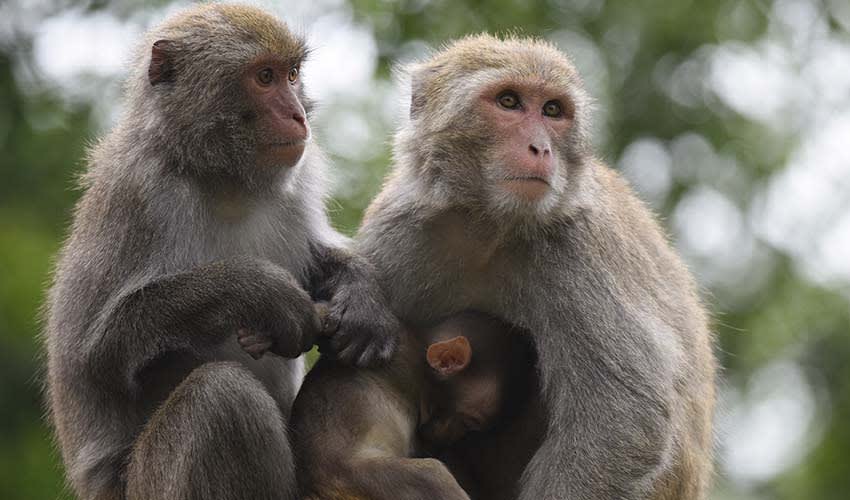
A lively, intelligent, and highly adaptable monkey native to Taiwan, where it stands as the island’s only native primate species. Endemic to the island, this macaque symbolizes Taiwan’s wild mountain forests and rugged beauty. Agile, social, and curious, the Formosan rock macaque thrives across Taiwan’s diverse landscapes—from misty mountain slopes to coastal cliffs—making it one of East Asia’s most fascinating and resilient primates.
The Formosan rock macaque is a medium-sized monkey. Their fur is thick and coarse, varying from grayish-brown to olive-brown, with lighter underparts and a slightly reddish tinge on the face and rump. The most striking feature is their expressive pinkish face, framed by tufts of fur that resemble sideburns. Their long, muscular tails aid in balance as they leap across cliffs or trees, a trait that distinguishes them from their short-tailed cousins. Their strong limbs, dexterous hands, and excellent climbing skills make them equally at home among rocky slopes, forest canopies, and even farmland edges.
Behaviorally, these macaques are highly social animals that live in multi-male, multi-female troops usually numbering between 20 and 50 individuals. Their societies are organized in strict hierarchies, with dominant males and females maintaining order through complex communication—facial expressions, vocalizations, and body postures. They are also remarkably adaptable: while they primarily inhabit evergreen and deciduous forests up to 3,000 meters (9,800 feet) above sea level, they have increasingly learned to live near human settlements and agricultural areas, often raiding crops and orchards for fruit, corn, or peanuts.
Diet-wise, the Formosan rock macaque is omnivorous, feeding on fruits, leaves, seeds, flowers, insects, and small animals. Seasonal changes in Taiwan’s mountains mean their diet varies throughout the year—fruits and seeds in the summer and autumn, tender leaves and buds in spring, and bark, roots, or insects during the winter. They are known to cache or carry food, and their dexterous fingers allow them to peel fruits and handle small objects skillfully.
Distribution
 Japan
Japan Taiwan
Anything we've missed?
Help us improve this page by suggesting edits. Glory never dies!
Suggest an editGet to know me
Terrestrial / Aquatic
Altricial / Precocial
Polygamous / Monogamous
Dimorphic (size) / Monomorphic
Active: Diurnal / Nocturnal
Social behavior: Solitary / Pack / Troop
Diet: Carnivore / Herbivore / Omnivore / Piscivorous / Insectivore
Migratory: Yes / No
Domesticated: Yes / No
Dangerous: Yes / No




