


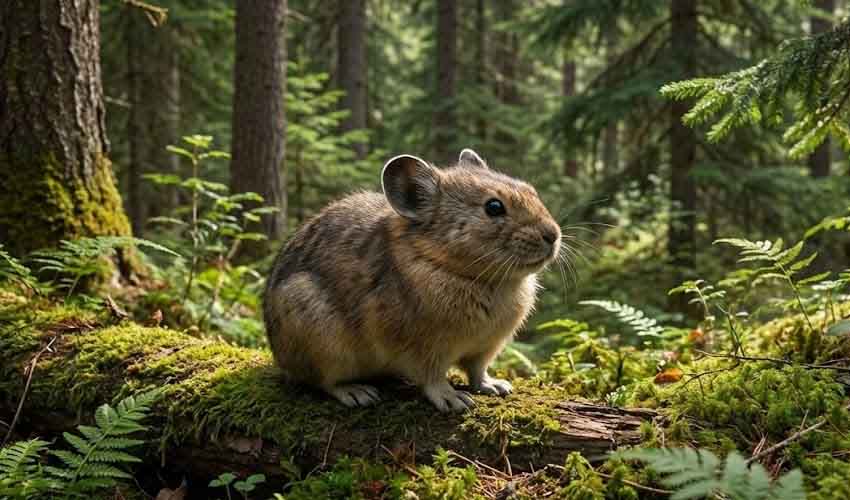
A small, tailless mountain mammal that can look like a rabbit that has been “shrunk” and rounded off for life in cold, steep country. It has short legs, small, rounded ears, and a compact body that seems made for quick dashes rather than long runs. In summer, its fur is often deep reddish-brown to almost blackish, giving it a rich, dark look in shadowy forests. In winter, it usually turns more gray-brown, like the color of weathered rock and dry leaves. Adults are typically about the length of a long hand (roughly 16–20 cm), and they have a sturdy, dense-coated feel—more like a pocket-sized mountaineer than a fluffy meadow bunny.
Forrest’s pika is often found in high-elevation forests and thick shrub patches in the eastern Himalaya region and nearby ranges, where light is dappled and hiding places are abundant. That darker summer coat helps it blend into damp soil, tree roots, and shaded stones. Some individuals are so dark that they were once described as a separate animal entirely—sometimes called the “black pika”—until later work suggested this was simply a color form of the same species. In other words, Forrest’s pika can come with a built-in “goth phase,” and that twist has fooled observers in the past.
Its face and ears can also carry little signature marks that set it apart when you get a good look. The ears are rounded and may show darker spots on the back, sometimes forming a faint collar-like pattern around the neck in some animals. These details might sound small, but in the pika world—where many species look similar at a glance—tiny differences in coloring and shape are part of what makes each one special. Another difference is its likely use of the landscape: instead of depending only on open rock fields, it can live where forests meet rocky slopes, using cracks, brush, and fallen wood as fast escape routes.
Distribution
 China
China Myanmar
Anything we've missed?
Help us improve this page by suggesting edits. Glory never dies!
Suggest an editGet to know me
Terrestrial / Aquatic
Altricial / Precocial
Polygamous / Monogamous
Dimorphic (size) / Monomorphic
Active: Diurnal / Nocturnal
Social behavior: Solitary / Pack / Herd
Diet: Carnivore / Herbivore / Omnivore / Piscivorous / Insectivore
Migratory: Yes / No
Domesticated: Yes / No
Dangerous: Yes / No




