


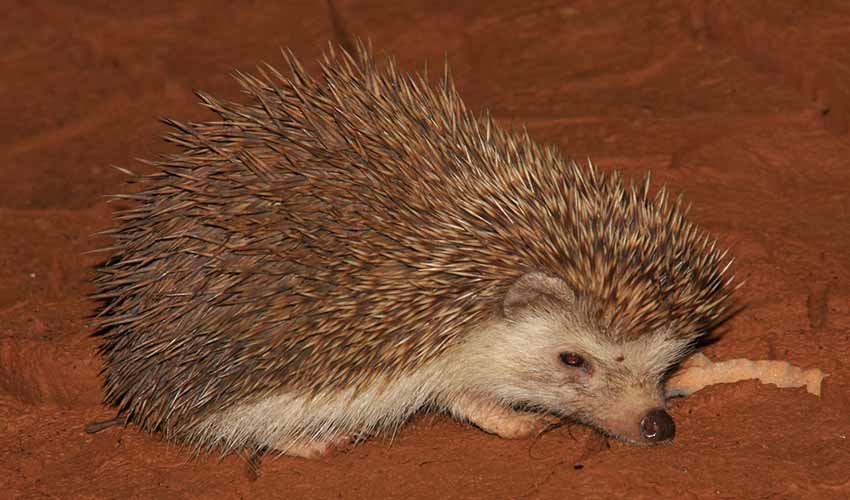
A small, spiky mammal from parts of Africa that looks like a prickly little bundle of confidence. It’s often called the African pygmy hedgehog in pet circles, but in the wild, it’s a hardy survivor built for grasslands, scrub, and the edges of farms and villages. Its body is covered in stiff spines that act like a wearable shield, while its face stays soft and expressive, with a pointed nose that’s always sniffing. As the name suggests, one of its simplest identifying traits is right on its feet: it typically has four toes on its hind feet, unlike some other hedgehogs that have five.
When a four-toed hedgehog feels threatened, it performs its signature move: it curls into a tight ball, pulling its head and legs inward so the spines face out in every direction. It’s a surprisingly effective defense—many predators decide that biting a pincushion isn’t worth the effort. But it isn’t just a passive spiky rock. When it’s relaxed and on the move, it can be quick, curious, and busy, trotting along with a low, snuffling gait. It relies heavily on smell and hearing to explore its world, because it’s often most active at night or in the cooler hours when it feels safer. During the day, it may rest in hidden spots, such as thick grass, leaf piles, or self-made nests tucked into sheltered corners.
Many people picture the rounder, heavier European hedgehog, but the four-toed hedgehog is typically smaller and better adapted to warmer environments. Its ears can appear relatively prominent, and its spines often exhibit a slightly different pattern and coloration compared with those of northern species. It also has a reputation for coping well with dry conditions, thanks to its flexible eating habits. Insects are a major part of its diet—beetles, worms, and other small invertebrates—but it may also eat other small prey and occasionally plant matter or fallen fruit when available.
Distribution
 Benin
Benin Burkina Faso
 Burundi
 Cameroon
 Central Af. Rep.
 Chad
Chad Côte D’ivoire
 DR Congo (Kinshasa)
 Djibouti
 Eritrea
 Ethiopia
 Gambia
 Ghana
Ghana Guinea
 Kenya
Kenya Mali
Mali Mauritania
 Mozambique
 Niger
Niger Nigeria
 Rwanda
 Senegal
 Sierra Leone
 Somalia
 Sudan
Sudan Tanzania
 Togo
Togo Uganda
 Zambia
Anything we've missed?
Help us improve this page by suggesting edits. Glory never dies!
Suggest an editGet to know me
Terrestrial / Aquatic
Altricial / Precocial
Polygamous / Monogamous
Dimorphic (size) / Monomorphic
Active: Diurnal / Nocturnal
Social behavior: Solitary / Pack / Herd
Diet: Carnivore / Herbivore / Omnivore / Piscivorous / Insectivore
Migratory: Yes / No
Domesticated: Yes / No
Dangerous: Yes / No




