


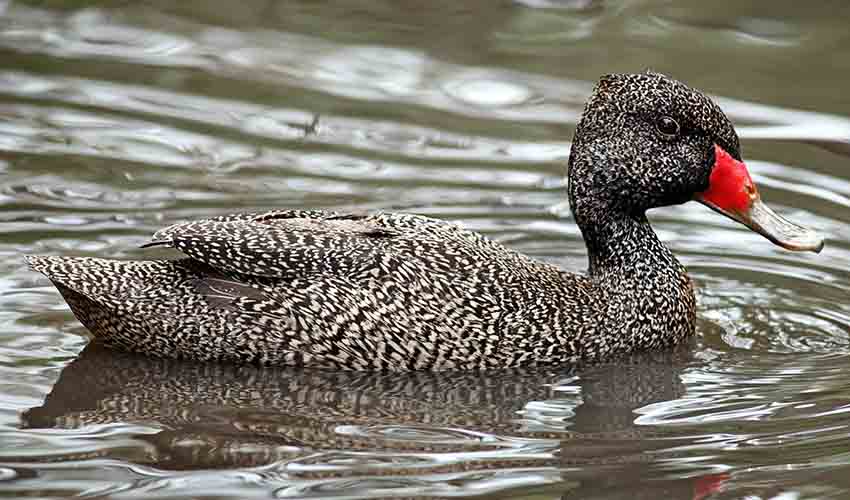
One of Australia’s most unusual waterfowl, and at first glance it looks like a bird designed in grayscale. Its plumage is a deep greyish-brown, evenly sprinkled with tiny pale spots that give it a soft “freckled” look all over, rather than bold patterns or bright colors. The head is large and slightly peaked at the back, and the bill is long, narrow, and just a little upturned, giving the duck a permanently thoughtful expression. Males and females look quite similar, but during the breeding season, the male’s bill base turns a striking red, as if someone has dipped it in wet paint. This crimson blush is one of the easiest ways to pick out a male in a group and adds a surprising splash of color to an otherwise subtle bird.
Although its shape and size can remind people of common Australian ducks like the Pacific black duck, closer study shows it behaves and feeds a bit differently. It’s considered a specialist filter-feeder, often straining tiny seeds, algae, and invertebrates from shallow water and soft mud. Instead of dabbling at the surface like many ducks, it uses its long bill to sift and scoop, making good use of wetlands with rich, muddy edges. This blend of familiar duck shape and unique feeding style is part of what makes the freckled duck a favorite among bird enthusiasts.
The freckled duck is also closely tied to the boom-and-bust nature of Australia’s inland wetlands. It breeds mainly in large, freshwater swamps and floodplains with thick vegetation, especially when heavy rains and floods create new, temporary wetlands. In these good years, pairs nest in dense cover, raising broods of ducklings among flooded shrubs and reeds. Once breeding is over and the inland begins to dry, the ducks disperse—sometimes over long distances—to more permanent lakes, reservoirs, and coastal wetlands.
Distribution
 Australia
 Official estimate
Anything we've missed?
Help us improve this page by suggesting edits. Glory never dies!
Suggest an editGet to know me
Terrestrial / Aquatic
Altricial / Precocial
Polygamous / Monogamous
Dimorphic (size) / Monomorphic
Active: Diurnal / Nocturnal
Social behavior: Solitary / Pack / Flock
Diet: Carnivore / Herbivore / Omnivore / Piscivorous / Insectivore
Migratory: Yes / No
Domesticated: Yes / No
Dangerous: Yes / No




