


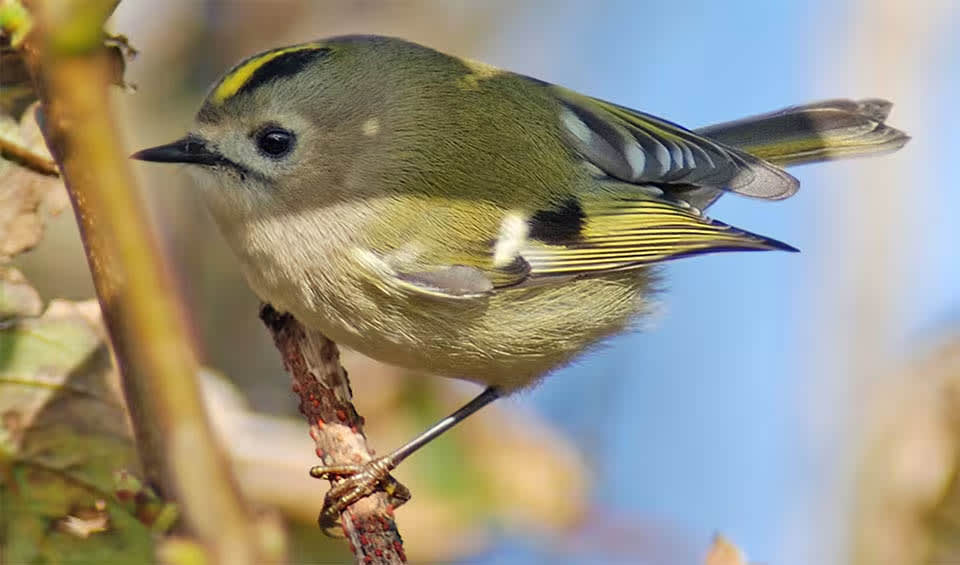
The goldcrest is Europe’s smallest bird, a tiny gem that weighs just about the same as a coin. With its vibrant yellow crest stripe atop its head, this bird is not just a delight to spot but also a marvel of nature’s design. The goldcrest’s name comes from this striking feature: a golden stripe bordered by black that runs across the top of its head, more prominent in males than in females. This colorful crest can be raised and fanned, especially during courtship or territorial disputes, adding to its distinctive appearance.
Goldcrests inhabit coniferous woodlands, gardens, and parks across Europe and parts of Asia. They are especially fond of spruce and fir trees where they can forage for insects and spiders. Their diet primarily consists of small invertebrates, which they adeptly pick from the bark and leaves with their fine, needle-like beaks. The agility of goldcrests is noteworthy; they often hang upside down on twigs to reach their prey, showcasing their acrobatic skills.
Goldcrests are resident birds in many parts of their range, but those living in the colder northern areas migrate southwards to escape the harsh winters. This migration is a risky journey due to their small size and the large distances involved. Yet, their presence in various parts of Europe, even during winter, is a testament to their resilience.
A fun fact about the goldcrest is its association with folklore. In Victorian times, it was often called the “king of the birds” in European folklore due to its regal crest and the old tale that describes it winning a competition among birds to fly the highest by hitching a ride on the back of an eagle, only to fly higher on its own when the eagle tired.
Distribution
 Afghanistan
 Albania
 Algeria
 Andorra
 Armenia
 Austria
 Azerbaijan
 Belarus
 Belgium
 Bhutan
 Bosnia And Herz.
 Bulgaria
 China
China Croatia
 Cyprus
 Czechia
 Denmark
 Estonia
 Faroe Islands
 Finland
 France
 Georgia
 Germany
 Greece
 Hungary
 Iran
Iran Ireland
 Israel
 Italy
Italy Japan
Japan Kazakhstan
 Korea
Korea Kyrgyzstan
 Latvia
 Lebanon
 Liechtenstein
 Lithuania
 Luxembourg
 Malta
Malta Moldova
 Mongolia
 Montenegro
 Myanmar
 Nepal
Nepal Netherlands
 North Korea
 North Macedonia
 Norway
 Poland
 Portugal
 Romania
 Russia
 Serbia
 Slovakia
 Slovenia
 Spain
Spain Sweden
 Switzerland
 Tajikistan
 Tunisia
 Turkey
 Ukraine
 United Kingdom
 Uzbekistan
Anything we've missed?
Help us improve this page by suggesting edits. Glory never dies!
Suggest an editGet to know me
Terrestrial / Aquatic
Altricial / Precocial
Polygamous / Monogamous
Dimorphic / Monomorphic (size)
Active: Diurnal / Nocturnal
Social behavior: Solitary / Pack / Flock
Diet: Carnivore / Herbivore / Omnivore / Piscivorous / Insectivore
Migratory: Yes / No
Domesticated: Yes / No
Dangerous: Yes / No




