


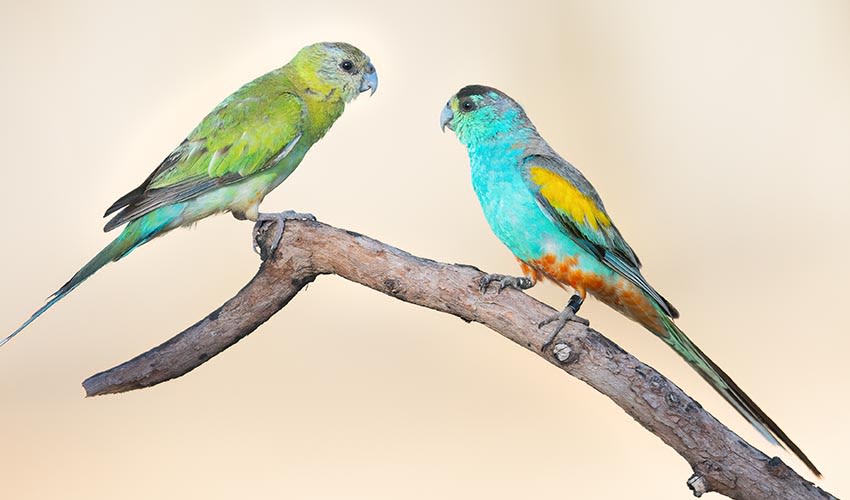
One of Australia’s most unusual and locally special parrots living in a small corner of far north Queensland. It’s a small, slim grass-parrot with a gentle, clean look: mostly soft green, with a pale face, a light blue wash on parts of the head, and—most famously—bright golden patches on the “shoulders” of its wings. Those golden panels can glow when sunlight hits them, like someone brushed the bird with metallic paint. Males tend to show bolder colors, while females are usually a little duller and have extra barring on the underside that helps them blend in.
Many parrots nest in tree hollows, but this species is famous for nesting in termite mounds. The pair chooses a tall mound, then digs a tunnel into it that ends in a nesting chamber safely inside. It’s a clever strategy: termite mounds are solid, well-insulated, and harder for some predators to break into than a simple tree hole. The mound also helps buffer heat and weather, which matters in a landscape that can swing from intense sun to heavy rains. This nesting habit is so distinctive that it’s often the first fact people learn about the species—and it’s a big reason the bird is considered one of Australia’s most fascinating parrots.
In everyday life, the golden-shouldered parrot is a ground-focused forager with a careful routine. It feeds mainly on grass seeds, especially from native grasses, and it often spends a lot of time on or near the ground, walking and picking rather than staying high in trees. Early morning and late afternoon are common “busy hours,” when the birds move between feeding spots and safer resting places. They can be quiet and hard to notice when they’re calmly feeding, but in flight they have a clean, purposeful style—fast wingbeats, quick turns, and then a sudden drop into cover.
Distribution
 Australia
 Official estimate
Anything we've missed?
Help us improve this page by suggesting edits. Glory never dies!
Suggest an editGet to know me
Terrestrial / Aquatic
Altricial / Precocial
Polygamous / Monogamous
Dimorphic (size) / Monomorphic
Active: Diurnal / Nocturnal
Social behavior: Solitary / Pack / Flock
Diet: Carnivore / Granivore / Omnivore / Piscivorous / Insectivore
Migratory: Yes / No
Domesticated: Yes / No
Dangerous: Yes / No




