


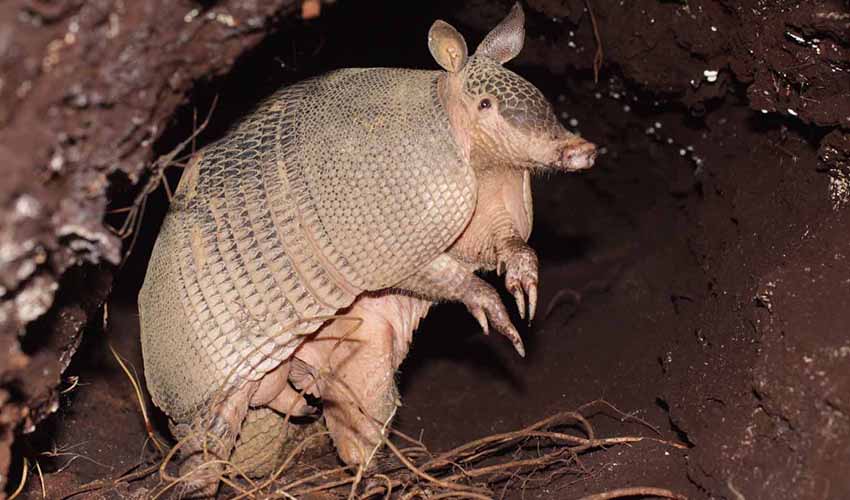
One of the more “classic-looking” armadillos—low-slung, armor-plated, and always sniffing as if it’s following an invisible trail. Its most noticeable feature is right in the name: a long, narrow snout that it uses like a living metal detector for food hidden under leaves, soil, or rotting wood. Its back is covered in tough, tiled plates, with several flexible bands across the middle that let it bend and twist as it walks, digs, or squeezes through tight gaps. The tail is sturdy and armored too, and the legs are short but powerful, ending in strong claws that look made for shoveling.
The greater long-nosed armadillo tends to be larger and heavier than many of its close relatives, with a more robust, “bulldozer” feel—less delicate, more muscular. That extra heft matters because it changes how it lives: a bigger body can break into tougher ground, push through thicker cover, and handle larger insect nests. It’s also more of a dedicated ground worker than a show-off defender. Unlike the three-banded armadillos that can curl into a tight, sealed ball, long-nosed armadillos—including this one—generally don’t rely on becoming a living sphere. Their safety plan is simpler and very effective: stay armored, stay alert, and keep an exit route to a burrow or dense cover.
Its daily routine revolves around food that most animals can’t easily access. The greater long-nosed armadillo is a serious insect hunter, especially fond of ants and termites, plus other small creatures it can uncover while digging. The long snout helps it probe into narrow cracks and openings, and its sense of smell does most of the guiding. Once it finds a promising spot, the claws take over, ripping into soil and nests with quick, practiced strokes. It often becomes active when the world is quieter and cooler—late afternoon into night—both to avoid the worst heat and to reduce the chance of being noticed.
Distribution
 Bolivia
 Brazil
 Colombia
 Ecuador
 French Guiana
 Guyana
 Peru
Peru Suriname
 Venezuela
Anything we've missed?
Help us improve this page by suggesting edits. Glory never dies!
Suggest an editGet to know me
Terrestrial / Aquatic
Altricial / Precocial
Polygamous / Monogamous
Dimorphic (size) / Monomorphic
Active: Diurnal / Nocturnal
Social behavior: Solitary / Pack / Herd
Diet: Carnivore / Herbivore / Omnivore / Piscivorous / Insectivore
Migratory: Yes / No
Domesticated: Yes / No
Dangerous: Yes / No




