


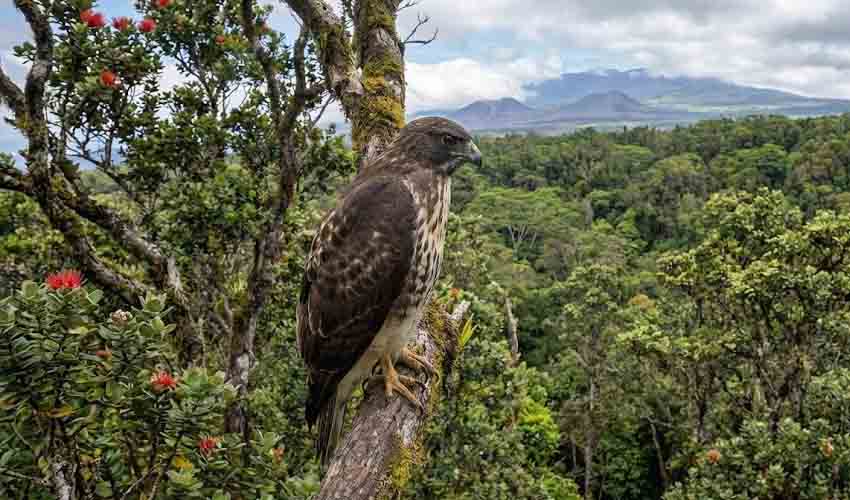
As the islands’ only native hawk, it holds a special place in both the natural ecosystem and Hawaiian culture. Medium-sized with broad wings and a strong build, the Hawaiian hawk is well-suited for soaring and gliding over forests, lava fields, and open countryside. Its coloring varies widely, ranging from dark brown to nearly black, or from pale brown to almost white, a feature that makes each individual appear unique.
Unlike many birds of prey that look fairly similar to one another, ʻio can look completely different even when living in the same area. This color variation does not affect their behavior or abilities, but it often surprises visitors who expect a single “typical” appearance. The hawk’s sharp eyes, hooked beak, and strong talons show its role as an efficient hunter, whether it is perched quietly or circling high above the landscape.
The Hawaiian hawk is highly adaptable and can be found in many habitats, including forests, grasslands, and agricultural areas. It often hunts by soaring high and scanning the ground, then dropping suddenly onto prey. Its diet includes small mammals, birds, insects, and reptiles. Because Hawaiʻi has relatively few native land predators, the Hawaiian hawk fills an important role in keeping animal populations balanced. Unlike many hawks that migrate, the ʻio stays on the island year-round, maintaining territories that may be used for many years.
Beyond its role in nature, the Hawaiian hawk is deeply important in Hawaiian culture. In traditional beliefs, the ʻio was seen as a symbol of strength, protection, and royal power. It was associated with Hawaiian chiefs and was considered a guardian spirit by some families. Seeing a ʻio in flight was often viewed as a meaningful or powerful sign. Even today, the bird remains a respected symbol of Hawaiʻi’s natural heritage and identity.
Distribution
 United States
 Official estimate
Anything we've missed?
Help us improve this page by suggesting edits. Glory never dies!
Suggest an editGet to know me
Terrestrial / Aquatic
Altricial / Precocial
Polygamous / Monogamous
Dimorphic (size) / Monomorphic
Active: Diurnal / Nocturnal
Social behavior: Solitary / Pack / Herd
Diet: Carnivore / Herbivore / Omnivore / Piscivorous / Insectivore
Migratory: Yes / No
Domesticated: Yes / No
Dangerous: Yes / No




