


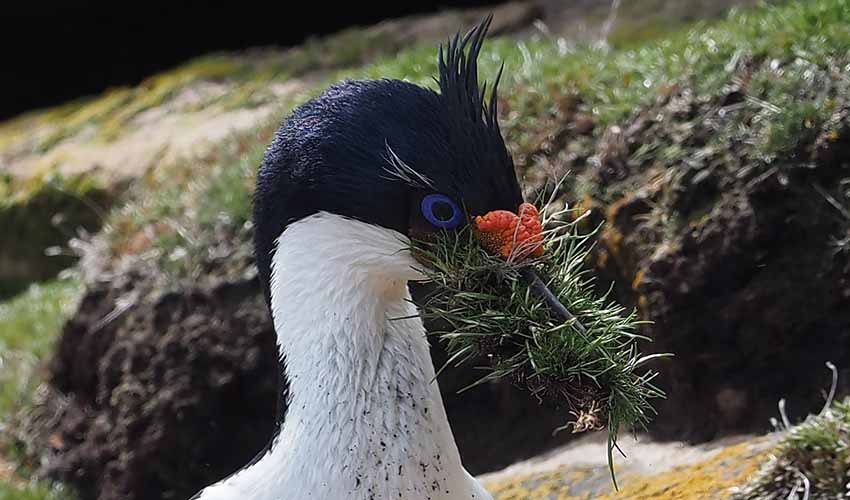
One of the most striking and widespread seabirds of the Southern Hemisphere. Found from the tip of South America to the subantarctic islands—including the Falklands and South Georgia—this bird is famous for its bold colors, excellent diving skills, and surprisingly social lifestyle. With its glossy black-and-white plumage, bright pink or orange feet, and vivid blue eye-ring during the breeding season, the Imperial shag is easily one of the most eye-catching birds in the cold southern seas.
The Imperial shag’s most iconic feature is its brilliant blue eye-ring, which glows like a neon halo during the breeding season. Paired with a small yellow or orange patch on the bill, this “facial makeup” becomes a key part of attracting mates. Their plumage is crisp and tuxedo-like, giving them an elegant appearance as they stand on rocky cliffs or dry their wings after diving. They are skilled and powerful swimmers, using their strong legs and partially waterproof feathers to dive deep—sometimes reaching over 60 meters (197 feet)—in search of fish, crustaceans, and small squid. Watching them surface with a fresh catch is a reminder of how well adapted they are to life in icy waters.
One of the most interesting things about the Imperial shag is its highly social behavior. These birds nest in dense colonies that can include thousands of individuals, creating bustling, noisy “seabird cities.” Their nests are surprisingly tall, made from seaweed, grass, mud, and even guano, often forming stacked or tower-like shapes after years of reuse and repair. Both parents share duties equally—taking turns incubating the egg and feeding the chick. Their strong pair bonds can last for many seasons, making them somewhat “romantic” among seabirds. On top of that, they often feed in groups, diving together like synchronized swimmers in coordinated hunts.
Distribution
 Antarctica
 Argentina
 Australia
 Chile
Chile Falkland Islands
 French Southern T.
Heard & McDonald
French Southern T.
Heard & McDonald South Africa
 South Georgia
Anything we've missed?
Help us improve this page by suggesting edits. Glory never dies!
Suggest an editGet to know me
Terrestrial / Aquatic
Altricial / Precocial
Polygamous / Monogamous
Dimorphic (size) / Monomorphic
Active: Diurnal / Nocturnal
Social behavior: Solitary / Pack / Flock
Diet: Carnivore / Herbivore / Omnivore / Piscivorous / Insectivore
Migratory: Yes / No
Domesticated: Yes / No
Dangerous: Yes / No




