


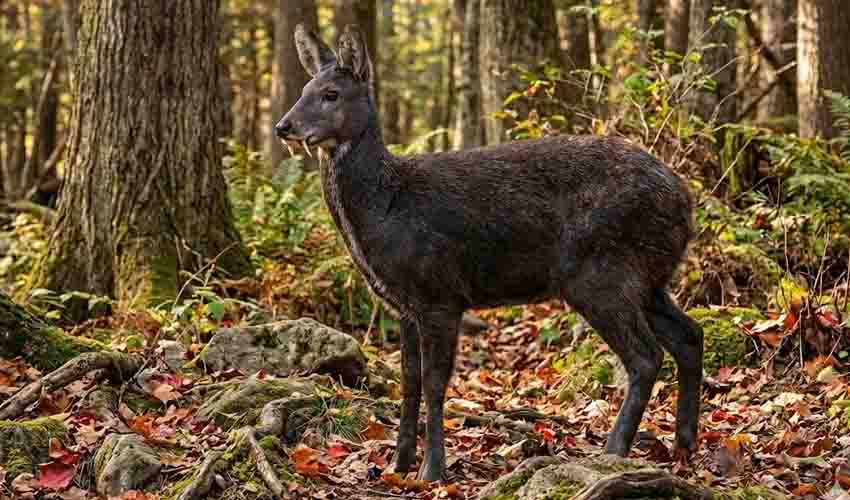
A small, shy mountain animal that looks deer-like at first glance, but it has a few features that make people do a double take. It has no antlers at all, a compact body, and long, slender legs made for steep slopes and quick, careful climbing. Its coat is thick and dense—usually gray-brown to dark brown—helping it blend into shadowy forests, rocky ground, and winter-dulled plants. The face is narrow with large ears that swivel constantly, as if it’s always scanning the world through sound.
What sets the Kashmir musk deer apart from other musk deer is its strong link to the western Himalaya and its preference for rugged, cool mountain habitats. It’s often associated with steep forested slopes and the kind of broken terrain where shrubs, rocks, and trees create endless hiding places. Rather than grazing openly like many hoofed animals, it lives like a shadow, moving through cover and avoiding wide open spaces. Its body design matches that lifestyle: not built for long chases across fields, but for short bursts and quick turns through thick plants. Compared with some other musk deer found farther east or in different mountain systems, the Kashmir musk deer is especially tied to a narrower Himalayan neighborhood, and that “local specialist” identity is part of what makes it feel rare and mysterious.
The Kashmir musk deer also stands out because it lives in a world of scent more than sight. Adult males produce musk from a special gland, and that scent is used mainly for communication, especially in the breeding season. In dense mountain forests, scent can carry information longer than a quick glimpse ever could, so musk deer rely on smell the way some animals rely on loud calls. They’re usually solitary and territorial, and they often use repeated droppings sites—regular “latrine” spots—to leave messages for neighbors about who’s around and whether a patch is already claimed.
Distribution
 Afghanistan
 India
India Pakistan
Anything we've missed?
Help us improve this page by suggesting edits. Glory never dies!
Suggest an editGet to know me
Terrestrial / Aquatic
Altricial / Precocial
Polygamous / Monogamous
Dimorphic (size) / Monomorphic
Active: Diurnal / Nocturnal
Social behavior: Solitary / Pack / Herd
Diet: Carnivore / Herbivore / Omnivore / Piscivorous / Insectivore
Migratory: Yes / No
Domesticated: Yes / No
Dangerous: Yes / No




