


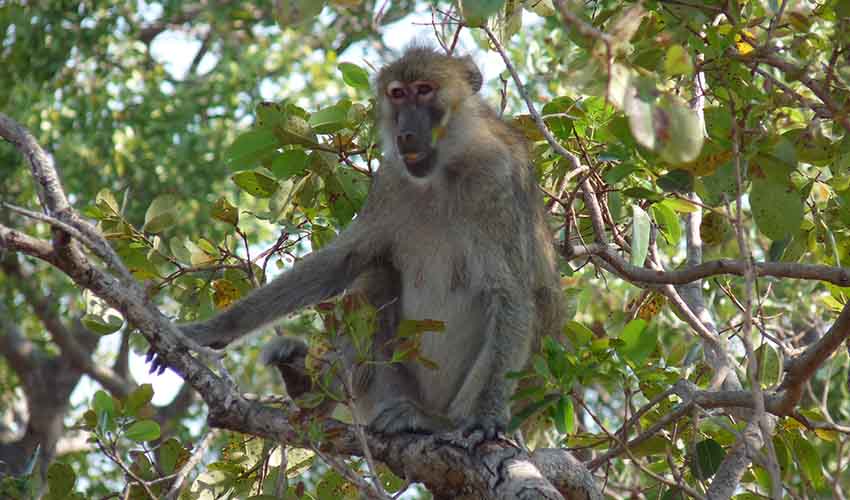
The smallest and one of the most softly colored baboons, living in the miombo woodlands and savannas of south-central Africa, especially parts of Angola, the Democratic Republic of the Congo, Zambia, and possibly western Tanzania. It has a light, golden-brown coat and a slim, lanky build that makes it look more delicate than the chunkier baboons most people know. Its fur tends to be longer and much softer than that of other baboon species, and its face is gentler too: a shorter snout, dark skin with pinkish rings around the eyes, and an overall “baby-faced” look even in adults.
Kinda baboons live in big, mixed groups with many males and many females, sometimes over a hundred animals, but inside these large herds are tighter friendship circles and family clusters. Females usually stay in the group they were born into, forming strong lifelong bonds with mothers, sisters, and daughters. Males, on the other hand, leave their birth group when they grow up and join new ones—but unlike the often rough, aggressive reputation of baboon males, Kinda males are known for being surprisingly gentle. They invest a lot in friendly relationships with females, spending long periods grooming them, sitting close, and generally acting more like calm companions than pushy bosses.
Their daily routine is a mix of travel, feeding, and social time. At dawn, the troop wakes up from sleeping sites in trees or on safe rocky outcrops and begins moving out in a loose procession, adults on all fours and youngsters trotting, riding on backs, or playing at the edges. They are omnivores: seeds, fruits, grass, roots, bulbs, insects, and the occasional small animal or egg all go onto the menu. Their cheek pouches act like built-in lunch bags, letting them quickly stuff food away and then chew it at leisure somewhere safer.
Distribution
 Angola
 DR Congo (Kinshasa)
 Tanzania
 Zambia
Anything we've missed?
Help us improve this page by suggesting edits. Glory never dies!
Suggest an editGet to know me
Terrestrial / Aquatic
Altricial / Precocial
Polygamous / Monogamous
Dimorphic (size) / Monomorphic
Active: Diurnal / Nocturnal
Social behavior: Solitary / Pack / Troop
Diet: Carnivore / Herbivore / Omnivore / Piscivorous / Insectivore
Migratory: Yes / No
Domesticated: Yes / No
Dangerous: Yes / No




