


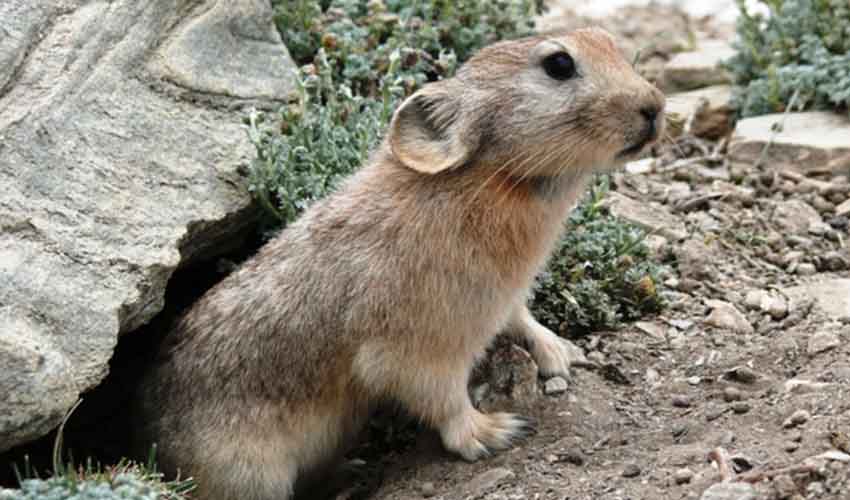
A small, tailless rabbit relative that looks like a pocket-sized, round-eared mountain runner. It has a compact body, short legs, and small, rounded ears rather than long “bunny” ears. Its fur is usually pale brown to gray on top with a lighter, yellowish or whitish underside, a color scheme that blends neatly with dusty slopes and dry alpine valleys. Many individuals show rusty tones on the outer parts of the ears, which can make the face look subtly “warm” even in cold places. In the hand, it feels sturdier than you’d expect—more solid and thick-coated than cute-and-delicate—because it lives where thin air, strong wind, and sudden freezes are normal.
What truly distinguishes the Ladak pika from many other pikas is its choice of home and its use of the ground. When people picture pikas, they often imagine them perched on piles of broken rock, diving into cracks like little cliff-dwellers. The Ladak pika can certainly use rocks, but it is especially known for digging deeper burrows in the soil of high, open valleys—more like an underground renter than a full-time rock-slope squatter. This is a big difference from several nearby Himalayan pikas that lean heavily on rock piles for shelter. The Ladak pika also stands out for size: it’s often described as among the largest pikas in its region, with a heavier, more robust build than many of its neighbors.
It also has a “local specialist” story that separates it from close relatives. For a long time, animals like it were confused with the plateau pika because they can look similar at a glance, especially from far away in harsh light. Over time, careful comparisons showed it is its own species, with its own range centered on the high mountains and plateaus spanning parts of northern India, northeastern Pakistan, and western China. It tends to live very high up where the growing season is short, and the weather flips quickly.
Distribution
 China
China India
IndiaAnything we've missed?
Help us improve this page by suggesting edits. Glory never dies!
Suggest an editGet to know me
Terrestrial / Aquatic
Altricial / Precocial
Polygamous / Monogamous
Dimorphic (size) / Monomorphic
Active: Diurnal / Nocturnal
Social behavior: Solitary / Pack / Herd
Diet: Carnivore / Herbivore / Omnivore / Piscivorous / Insectivore
Migratory: Yes / No
Domesticated: Yes / No
Dangerous: Yes / No




