


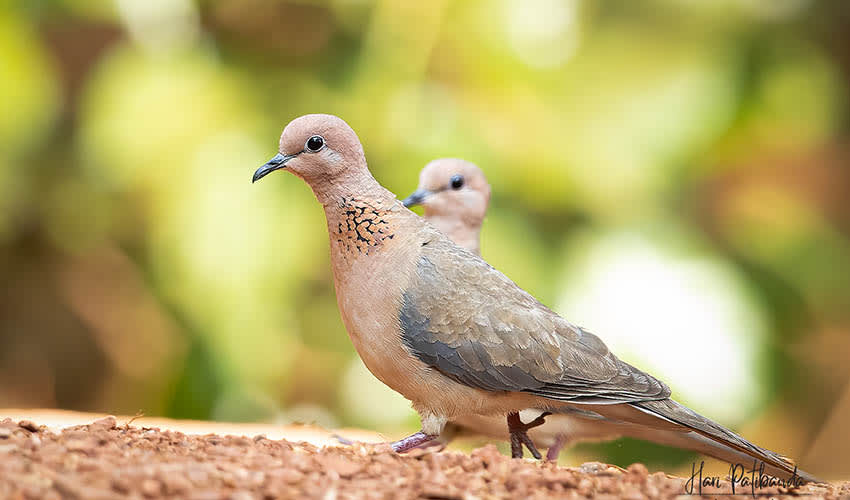
True to its name, the bird is best known for its distinctive call—a soft, bubbling “coo-coo-coo” that rises and falls in rhythm, sounding remarkably like gentle laughter. This musical voice makes it a familiar sound in gardens, parks, and farmlands, where it often perches on rooftops or telephone wires, filling the air with its gentle “laughter.”
In appearance, the laughing dove is delicate and graceful. Its most beautiful feature is the neck patch of black-and-rufous speckles, which gives it a necklace-like look and a touch of elegance. The wings show soft blues and browns, and the underparts are flushed with a warm rose color, especially in good light. Unlike some of the chunkier city pigeons, laughing doves are slim, neat, and dainty, which only adds to their charm.
Behaviorally, they are gentle, social birds often seen in pairs or small family groups. They feed mainly on the ground, pecking at seeds, grains, and small insects, and they have adapted remarkably well to human-altered landscapes. Unlike shy forest pigeons, the laughing dove thrives in villages, towns, and agricultural areas, making it one of the most widespread doves in its range. They are also known for their graceful flight: when disturbed, they rise quickly with fast wingbeats before gliding down in smooth arcs, flashing their long tails.
Breeding is another area where the laughing dove is fascinating. Like many doves, they build simple, flimsy nests of twigs, often in low trees, bushes, or even on window ledges and house beams. Despite their casual nest-building style, they are highly devoted parents, with both male and female sharing incubation and chick-rearing duties. The parents feed their young with “pigeon milk,” a rich, nutritious secretion from their crops that helps the chicks grow rapidly.
Distribution
 Afghanistan
 Algeria
 Angola
 Australia
 Azerbaijan
 Bahrain
 Bangladesh
 Benin
Benin Bhutan
 Botswana
 Bulgaria
 Burkina Faso
 Burundi
 Cameroon
 Central Af. Rep.
 Chad
Chad China
China Cyprus
 Côte D’ivoire
 DR Congo (Kinshasa)
 Djibouti
 Egypt
Egypt Eritrea
 Eswatini
 Ethiopia
 Finland
 Gabon
Gabon Gambia
 Ghana
Ghana Greece
 Guinea-Bissau
 Guinea
 India
India Iran
Iran Iraq
Iraq Israel
 Italy
Italy Jordan
 Kazakhstan
 Kenya
Kenya Kuwait
 Kyrgyzstan
 Lebanon
 Lesotho
 Liberia
 Libya
Libya Malawi
 Mali
Mali Malta
Malta Mauritania
 Morocco
 Mozambique
 Namibia
 Nepal
Nepal Niger
Niger Nigeria
 Oman
Oman Pakistan
 Portugal
 Qatar
Qatar Rwanda
 Saudi Arabia
 Senegal
 Sierra Leone
 Somalia
 South Africa
 South Sudan
 Spain
Spain Sudan
Sudan Syria
Syria São Tomé & Príncipe
 Tajikistan
 Tanzania
 Togo
Togo Tunisia
 Turkmenistan
 Turkey
 UAE
UAE Uganda
 Uzbekistan
 Yemen
Yemen Zambia
 Zimbabwe
Anything we've missed?
Help us improve this page by suggesting edits. Glory never dies!
Suggest an editGet to know me
Terrestrial / Aquatic
Altricial / Precocial
Polygamous / Monogamous
Dimorphic (size) / Monomorphic
Active: Diurnal / Nocturnal
Social behavior: Solitary / Pack / Flock
Diet: Carnivore / Granivore / Omnivore / Piscivorous / Insectivore
Migratory: Yes / No
Domesticated: Yes / No
Dangerous: Yes / No




