


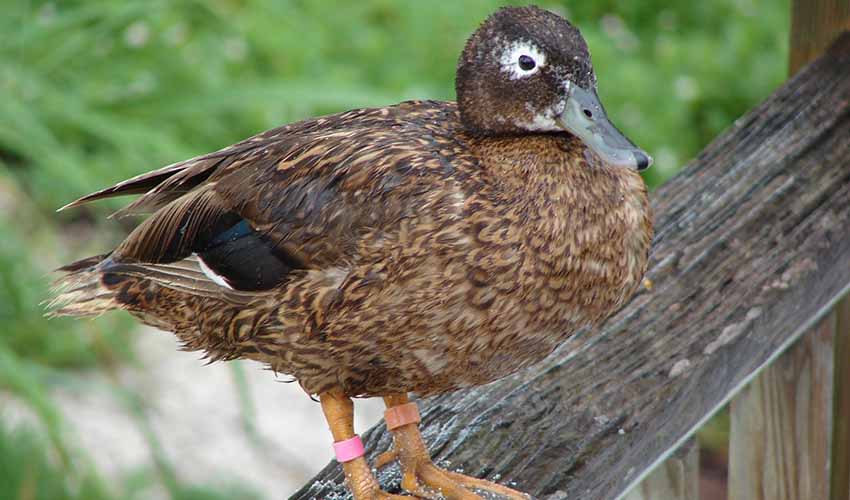
Endemic to the Hawaiian Islands, this species once ranged across the entire archipelago but now survives only on a few remote atolls. Despite its modest appearance, the Laysan duck represents one of the great conservation success stories of modern times—a living symbol of resilience, adaptation, and hope for endangered species everywhere.
Physically, the Laysan duck is a small, compact dabbling duck. It has a warm brown plumage mottled with darker spots, a bright green speculum (the iridescent patch on its wings), and a dark eye patch that gives it a curious, expressive look. Its legs and feet are orange, and males and females look quite similar, though males tend to have slightly glossier heads and richer coloration.
Once widespread across the Hawaiian chain, it was driven to near extinction by habitat destruction, hunting, and especially by the introduction of rats, pigs, and rabbits by humans. These invasive species destroyed nesting grounds and food sources, leaving the duck’s population confined to a single island: Laysan Island, a tiny coral atoll in the Northwestern Hawaiian Islands. By the early 1900s, the Laysan duck was thought to be nearly gone—its population dropping to fewer than 30 individuals. For decades, it was considered one of the rarest birds in the world, surviving in a fragile ecosystem barely a few kilometers across.
But the Laysan duck proved astonishingly resilient. On Laysan Island, it adapted to its environment in ingenious ways. Unlike most ducks, it became largely flightless, conserving energy in a habitat with no mammalian predators. It evolved an unusual feeding behavior known as “fly-snapping”—darting its bill through the air to catch brine flies and other insects, an adaptation to the island’s limited freshwater and vegetation.
Distribution
 United States
 Official estimate
Anything we've missed?
Help us improve this page by suggesting edits. Glory never dies!
Suggest an editGet to know me
Terrestrial / Aquatic
Altricial / Precocial
Polygamous / Monogamous
Dimorphic (size) / Monomorphic
Active: Diurnal / Nocturnal
Social behavior: Solitary / Pack / Herd
Diet: Carnivore / Herbivore / Omnivore / Piscivorous / Insectivore
Migratory: Yes / No
Domesticated: Yes / No
Dangerous: Yes / No




