


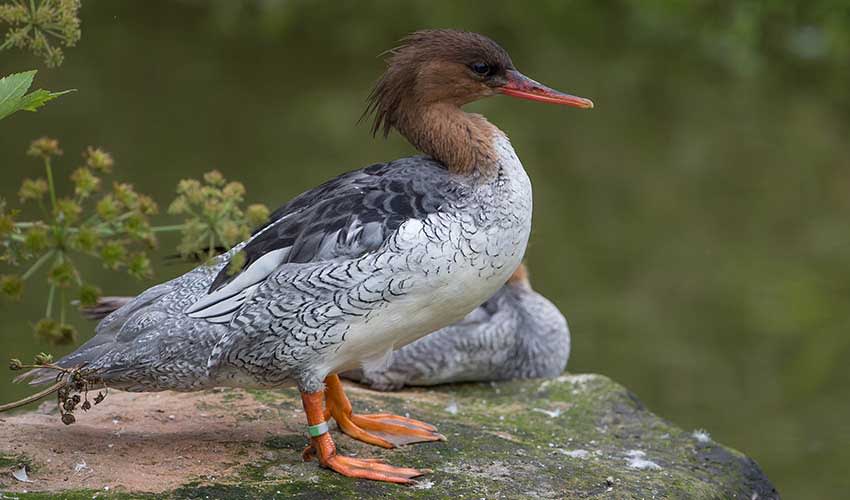
Its name comes from the beautiful “scale” pattern along its flanks, where pale feathers are edged in dark lines that resemble rows of overlapping fish scales. Adult males are especially striking: they have a glossy dark head with a shaggy crest, a red bill, creamy underparts, and those bold scaly sides that seem almost hand-painted. Females trade the black head for a warm brown one, but they keep the same elegant shape and patterned flanks, giving both sexes a graceful, detailed look that sets them apart from other ducks.
What truly makes this species unusual is where it lives and nests. Instead of peaceful lakes or marshes, the scaly-sided merganser depends on clear, fast-flowing rivers running through old, mature forests in a narrow region of Northeast Asia. Most of the world’s population breeds along forest rivers in the Russian Far East and northeastern China, with a few likely in North Korea.
In winter, they migrate south to larger rivers and reservoirs in China, Korea, Japan, and nearby areas. Even more unusual is their nesting strategy: they are extreme tree-nesters. Rather than building nests on the ground, they rely on natural cavities in tall riverside trees, often using old woodpecker holes or nest boxes mounted high above the water. Because they cannot make their own cavities, they are heavily dependent on ancient riverside trees to raise their young.
Everything about this duck reflects its intimate connection with moving water. Scaly-sided mergansers dive in swift currents to catch small fish and aquatic insects, using their long, narrow, saw-edged bills to grip slippery prey. They prefer mid-sized rivers with clean, clear water and quiet gravel bars where they can rest between dives. When breeding season arrives and the female selects a cavity for her nest, the adventure is just beginning. Once the eggs hatch, the ducklings must leap from the high nest hole—sometimes several meters up—and tumble down to the river below, where they immediately begin swimming and feeding.
Distribution
 China
China Hong Kong
 Japan
Japan Korea
Korea North Korea
 Russia
 Taiwan
Anything we've missed?
Help us improve this page by suggesting edits. Glory never dies!
Suggest an editGet to know me
Terrestrial / Aquatic
Altricial / Precocial
Polygamous / Monogamous
Dimorphic (size) / Monomorphic
Active: Diurnal / Nocturnal
Social behavior: Solitary / Pack / Flock
Diet: Carnivore / Herbivore / Omnivore / Piscivorous / Insectivore
Migratory: Yes / No
Domesticated: Yes / No
Dangerous: Yes / No




