


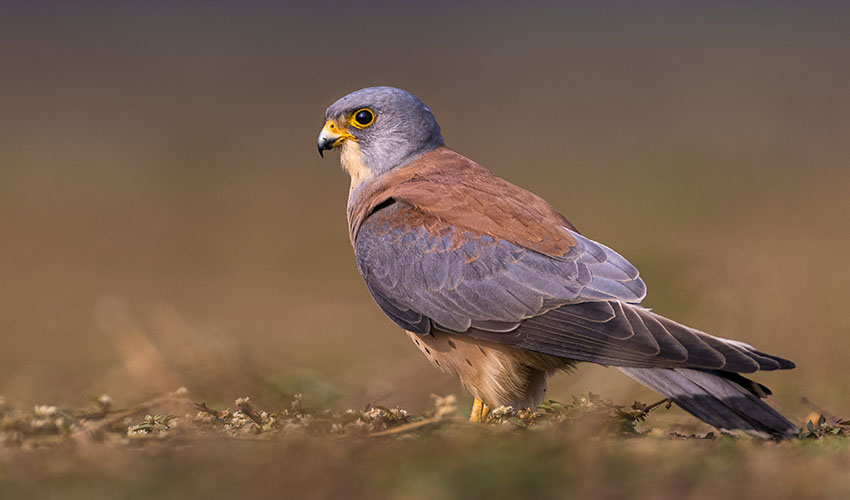
A small, graceful falcon that brings a light, buoyant energy to open skies across southern Europe, North Africa, the Middle East, and Central Asia. Slightly smaller and more delicate than the common kestrel, this species favors warm, open landscapes such as farmland, dry grasslands, steppe, and semi-deserts. It’s strongly migratory, spending the breeding season across Europe and western Asia before traveling south to sub-Saharan Africa for the winter, often gathering in large roosts that can fill traditional village centers or shade trees along river valleys.
In appearance, the male lesser kestrel stands out with its pale chestnut back, bluish-gray head and tail, and clean, lightly spotted plumage. Unlike the common kestrel, it lacks the heavy black spotting and bold streaks that give its relative a more rugged look. Females and young birds are warm brown with subtle barring and a softer, sandy tone overall — ideal camouflage for sun-baked fields. The species’ flight style is characteristically light and fluttery, marked by agile twists and quick wingbeats. While it can hover like its relatives, it often glides low over fields or perches on wires and old buildings to search for prey, giving it a relaxed, almost effortless feel in the air.
Diet plays a key role in distinguishing the lesser kestrel from its larger cousins. Rather than focusing heavily on mammals, it primarily hunts large insects — especially grasshoppers, locusts, crickets, and beetles — along with occasional small reptiles and rodents. This insect-based diet makes it particularly dependent on traditional agricultural systems and natural grasslands, where prey remains abundant. When it spots food, the bird drops into quick stoops or smooth swoops, sometimes snatching insects directly from the ground in neat, precise movements.
Distribution
 Afghanistan
 Albania
 Algeria
 Angola
 Armenia
 Austria
 Official estimate
 Azerbaijan
 Bahrain
 Bangladesh
 Belgium
 Benin
Benin Bosnia And Herz.
 Botswana
 Bulgaria
 Burkina Faso
 Burundi
 Cambodia
 Cameroon
 Central Af. Rep.
 Chad
Chad China
China Congo-Brazzaville
 Croatia
 Cyprus
 Czechia
Official estimate
Czechia
Official estimate
 Côte D’ivoire
 DR Congo (Kinshasa)
 Denmark
 Djibouti
 Egypt
Egypt Eritrea
 Eswatini
 Ethiopia
 France
 Gabon
Gabon Gambia
 Georgia
 Germany
 Ghana
Ghana Gibraltar
 Greece
 Guinea
 India
India Iran
Iran Iraq
Iraq Ireland
 Israel
 Italy
Italy Japan
Japan Jordan
 Kazakhstan
 Kenya
Kenya Kuwait
 Kyrgyzstan
 Laos
Official estimate
Laos
Official estimate
 Lebanon
 Lesotho
 Liberia
 Libya
Libya Liechtenstein
 Malawi
 Maldives
 Mali
Mali Malta
Malta Mauritania
 Moldova
 Mongolia
 Montenegro
 Morocco
 Mozambique
 Myanmar
 Namibia
 Nepal
Nepal Niger
Niger Nigeria
 North Macedonia
 Oman
Oman Pakistan
 Portugal
 Qatar
Qatar Romania
 Russia
 Rwanda
 Saudi Arabia
 Senegal
 Serbia
 Seychelles
 Sierra Leone
 Singapore
 Slovakia
Official estimate
Slovakia
Official estimate
 Slovenia
Official estimate
Slovenia
Official estimate
 Somalia
 South Africa
 South Sudan
 Spain
Spain Sri Lanka
 Sudan
Sudan Sweden
 Syria
Syria Tajikistan
 Tanzania
 Togo
Togo Tunisia
 Turkmenistan
 Turkey
 UAE
UAE Uganda
 Ukraine
 United Kingdom
 Uzbekistan
 Yemen
Yemen Zambia
 Zimbabwe
Anything we've missed?
Help us improve this page by suggesting edits. Glory never dies!
Suggest an editGet to know me
Terrestrial / Aquatic
Altricial / Precocial
Polygamous / Monogamous
Dimorphic (size) / Monomorphic
Active: Diurnal / Nocturnal
Social behavior: Solitary / Pack / Herd
Diet: Carnivore / Herbivore / Omnivore / Piscivorous / Insectivore
Migratory: Yes / No
Domesticated: Yes / No
Dangerous: Yes / No




