


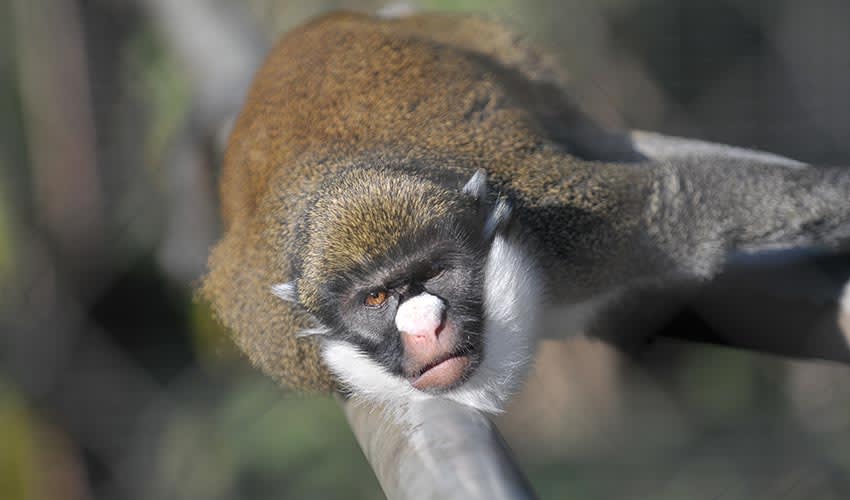
One of West Africa’s most charming and easily recognizable guenons, known for the distinctive white spot on its nose and its gentle, quiet nature. Found from Côte d’Ivoire, Ghana, Togo, Benin, and Nigeria, this small monkey inhabits rainforests, swamp forests, secondary growth, and forest-savanna mosaics.
This little monkey earns its name from the prominent white spot on the tip of its nose—a bright contrast against its dark muzzle. The rest of its face features soft white cheek patches and expressive eyes framed by a darker forehead. Its coat is typically olive-green, grayish, or brownish with subtle flecking, blending well with the dappled light of the African forest understory. Compared to other guenons, it is relatively small, giving it an agile and delicate appearance. Its long tail, which often exceeds its body length, helps it balance deftly as it moves through vines, branches, and dense leaves.
The Lesser spot-nosed monkey is an arboreal species, spending much of its time in the mid-story and understory layers of the forest. It is an agile climber and tends to move quietly, unlike some of the louder guenons. While it rarely occupies the high canopy, it thrives in thicker vegetation closer to the ground, where it can forage among bushes, lianas, and low tree branches. This preference for dense cover helps it stay safe from predators such as crowned eagles, leopards, pythons, and forest civets.
Its diet is diverse and opportunistic. The Lesser spot-nosed monkey eats fruits, seeds, young leaves, buds, insects, and small invertebrates. It is especially adept at foraging for hidden insects in leaf clusters or beneath bark, using quick hand movements and keen eyesight. Like other guenons, it has cheek pouches that allow it to store food while it looks for a safer location to eat. Because they consume a wide variety of fruit, they are valuable seed dispersers, aiding forest regeneration and plant diversity.
Distribution
 Côte D’ivoire
 Ghana
Ghana Guinea-Bissau
 Guinea
 Liberia
 Sierra Leone
 Togo
TogoAnything we've missed?
Help us improve this page by suggesting edits. Glory never dies!
Suggest an editGet to know me
Terrestrial / Aquatic
Altricial / Precocial
Polygamous / Monogamous
Dimorphic (size) / Monomorphic
Active: Diurnal / Nocturnal
Social behavior: Solitary / Pack / Troop
Diet: Carnivore / Herbivore / Omnivore / Piscivorous / Insectivore
Migratory: Yes / No
Domesticated: Yes / No
Dangerous: Yes / No




