


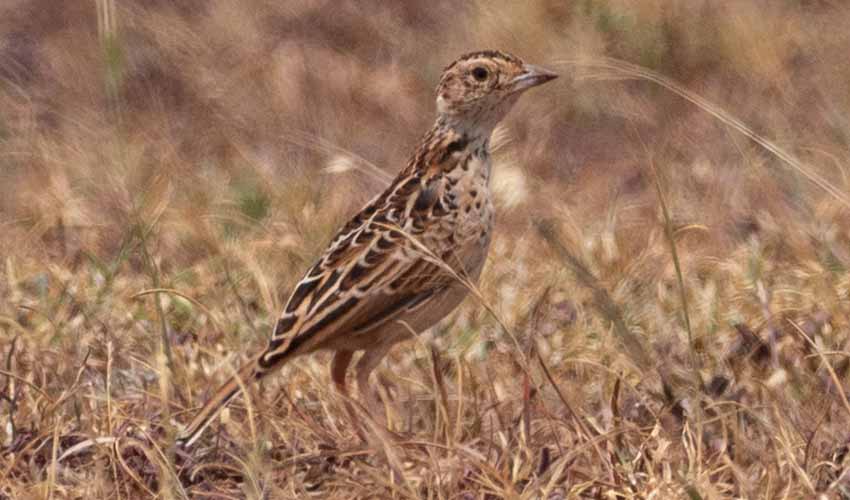
An incredibly rare and elusive bird that calls the vanishing grasslands of the Horn of Africa home, making it a focus of intense conservation efforts. If you are familiar with typical larks—which are widely celebrated for their slender, elegant profiles and their habit of launching high into the sky to perform spectacular, echoing flight songs—the liben lark stands out as a stark contrast.
When you compare it to its famous, soaring cousins, its most distinctive physical characteristic is its rather unusual proportions. It features a surprisingly large, heavy-set head perched on a short, plump little body. Furthermore, instead of a long, broad tail used for aerial acrobatics, the Liben lark possesses a noticeably stubby, thin tail edged with stark white feathers. Its plumage is a highly camouflaged mix of warm reddish-browns and buffs, complete with a heavily streaked chest that allows it to practically melt into the dry earth and scrub brush of its habitat.
Beyond its unique, compact appearance, the Liben lark’s daily life is defined by extreme secrecy. While other larks love to sing proudly from exposed fence posts or bushes, this bird is intensely terrestrial and incredibly shy. Even though it is fully capable of flight, it strongly prefers to keep its feet firmly planted on the ground. When it feels threatened by an approaching observer, it rarely takes to the air. Instead, it relies entirely on its cryptic coloring, hunching down and sprinting rapidly through the dense clumps of tall grass like a tiny, feathered mouse. It spends its days quietly foraging in the dirt for a simple diet of small seeds, worms, and insects, making it famously difficult for even the most dedicated wildlife watchers to spot in the wild.
Distribution
 Ethiopia
 Somalia
Anything we've missed?
Help us improve this page by suggesting edits. Glory never dies!
Suggest an editGet to know me
Terrestrial / Aquatic
Altricial / Precocial
Polygamous / Monogamous
Dimorphic (size) / Monomorphic
Active: Diurnal / Nocturnal
Social behavior: Solitary / Pack / Herd
Diet: Carnivore / Herbivore / Omnivore / Piscivorous / Insectivore
Migratory: Yes / No
Domesticated: Yes / No
Dangerous: Yes / No




