


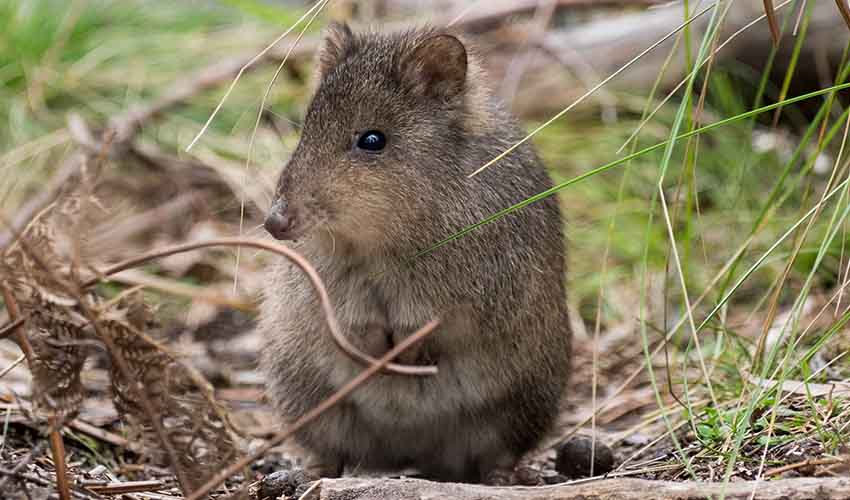
A small, shy marsupial that looks like a mix between a tiny kangaroo and a big, long-nosed rat. It lives in south-eastern Australia and Tasmania, mostly in dense heathy or shrubby ground where it can hide easily. Its body is about rabbit-sized, with a rounded back, short neck, and a long, pointed snout that’s perfect for sniffing through leaf litter. The fur is usually grey-brown to brown on top and paler underneath, often with a slightly grizzled look, and the tail is fairly long, thin, and sparsely furred. When it moves, it doesn’t scurry like a mouse—it hops on its strong back legs in short bounds, using its smaller front paws for digging and handling food, just like a mini kangaroo built for life in the undergrowth.
Long-nosed potoroos are night-time diggers and truffle hunters. After dark they come out from nests hidden in thick vegetation or under fallen logs and begin to forage, nose close to the ground. Their favourite foods are underground fungi (often called “truffles”), along with roots, tubers, seeds, insects, and other small invertebrates. To find truffles, they sniff out the scent and then dig lots of small, conical holes with their front paws. These little pits are a classic sign that potoroos are around.
By eating fungi and then spreading the spores in their droppings, they play a crucial role in keeping forests healthy: many Australian trees and shrubs rely on those fungi on their roots to help them get nutrients and water. So a long-nosed potoroo is basically a furry, hopping gardener, quietly tending the underground “fungus network” that supports the plants above.
They’re also very shy, low-profile animals. Long-nosed potoroos spend the day tucked away in nests made from grass, ferns, and leaves, often under dense shrubs or in the shelter of bracken and fallen branches. They prefer areas with thick ground cover and plenty of places to hide from foxes, cats, and birds of prey.
Distribution
 Australia
 Official estimate
Anything we've missed?
Help us improve this page by suggesting edits. Glory never dies!
Suggest an editGet to know me
Terrestrial / Aquatic
Altricial / Precocial
Polygamous / Monogamous
Dimorphic (size) / Monomorphic
Active: Diurnal / Nocturnal
Social behavior: Solitary / Pack / Herd
Diet: Carnivore / Herbivore / Omnivore / Piscivorous / Insectivore
Migratory: Yes / No
Domesticated: Yes / No
Dangerous: Yes / No




