


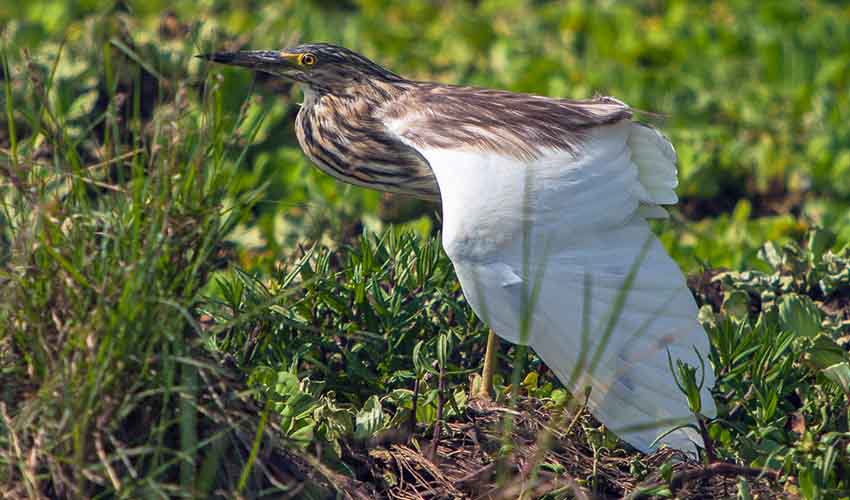
A small, elegant waterbird found mainly on the island of Madagascar and a few nearby islands in the western Indian Ocean. It belongs to the group of herons known as pond herons, birds famous for their ability to look plain and ordinary one moment and surprisingly beautiful the next. When standing quietly at the edge of a marsh or rice field, the Malagasy pond heron usually appears brown, streaky, and a little scruffy—perfectly camouflaged against mud, reeds, and dry grasses. But when it takes flight, it suddenly transforms, flashing bright white wings and a clean white body that can look almost dazzling against green wetlands or blue water.
What makes the Malagasy pond heron distinct from other pond herons is its limited range and its seasonal change in appearance. Most of the year it wears dull, earthy colors that help it disappear into the background. During the breeding season, however, it becomes much more eye-catching. The feathers on the neck and back turn rich chestnut and buff, and long delicate plumes may appear, giving the bird a refined, dressed-up look. This transformation is important for attracting mates and for social life at nesting colonies.
In daily life, this heron is a quiet and patient hunter. It prefers shallow freshwater habitats such as ponds, lakes, marshes, river edges, and flooded rice fields. Instead of wading into deep water like larger herons, it usually stays in the shallows, standing still for long periods while watching for prey. Its diet includes small fish, frogs, insects, and other tiny creatures that live in wet places. When something moves within reach, the bird makes a quick, precise strike with its sharp bill. Because it hunts in small, everyday wetlands rather than dramatic coastlines, it often lives close to villages and farms, where it has learned to take advantage of human-made water channels and paddies.
Distribution
 Angola
 Burundi
 Comoros
 DR Congo (Kinshasa)
 Kenya
Kenya Madagascar
 Malawi
 Mayotte
 Mozambique
 Rwanda
Réunion
Rwanda
Réunion Seychelles
 Somalia
 Tanzania
 Uganda
 Yemen
Yemen Zambia
 Zimbabwe
Anything we've missed?
Help us improve this page by suggesting edits. Glory never dies!
Suggest an editGet to know me
Terrestrial / Aquatic
Altricial / Precocial
Polygamous / Monogamous
Dimorphic (size) / Monomorphic
Active: Diurnal / Nocturnal
Social behavior: Solitary / Pack / Herd
Diet: Carnivore / Herbivore / Omnivore / Piscivorous / Insectivore
Migratory: Yes / No
Domesticated: Yes / No
Dangerous: Yes / No




