


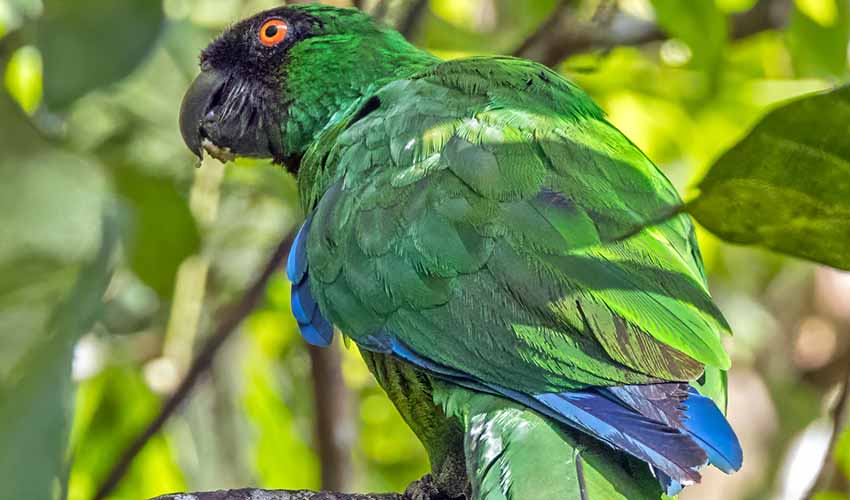
Native to the island of Viti Levu in Fiji, this parrot immediately stands out because of the dark, mask-like markings on its face, which contrast sharply with its bright green body. The head and face show deep black and rich blue tones, giving the bird an intense and expressive look. Its wings and back are a strong glossy green, while touches of red and blue add extra brilliance to its appearance.
This parrot is closely tied to Fiji’s tropical forests, where it spends most of its life high in the canopy. It prefers mature forests with tall trees that provide food, shelter, and nesting sites. The masked shining parrot feeds mainly on fruits, seeds, berries, and flowers, moving deliberately through branches as it searches for ripe food. By feeding on a wide range of plants, it plays an important role in spreading seeds and supporting forest regeneration. Although it is a strong flyer, it is often seen perched quietly, observing its surroundings before making short, purposeful flights.
Social behavior is an important part of the masked shining parrot’s life. These birds are most often seen in pairs or small family groups rather than large flocks. Mated pairs form strong, lasting bonds and usually stay close together while feeding, resting, or flying. Their calls are loud and resonant, carrying through the forest to help partners stay in contact even when hidden by dense foliage.
While its bold facial markings make it one of the most visually striking parrots in Fiji, it is not constantly noisy or frantic. Instead, it moves with a sense of purpose and authority, giving it a dignified presence in the forest. Its limited range also makes it especially unique, as it exists only in a small part of the world and is closely tied to the health of its island habitat.
Distribution
 Fiji
Fiji Official estimate
Anything we've missed?
Help us improve this page by suggesting edits. Glory never dies!
Suggest an editGet to know me
Terrestrial / Aquatic
Altricial / Precocial
Polygamous / Monogamous
Dimorphic (size) / Monomorphic
Active: Diurnal / Nocturnal
Social behavior: Solitary / Pack / Flock
Diet: Carnivore / Frugivore / Omnivore / Piscivorous / Insectivore
Migratory: Yes / No
Domesticated: Yes / No
Dangerous: Yes / No




