


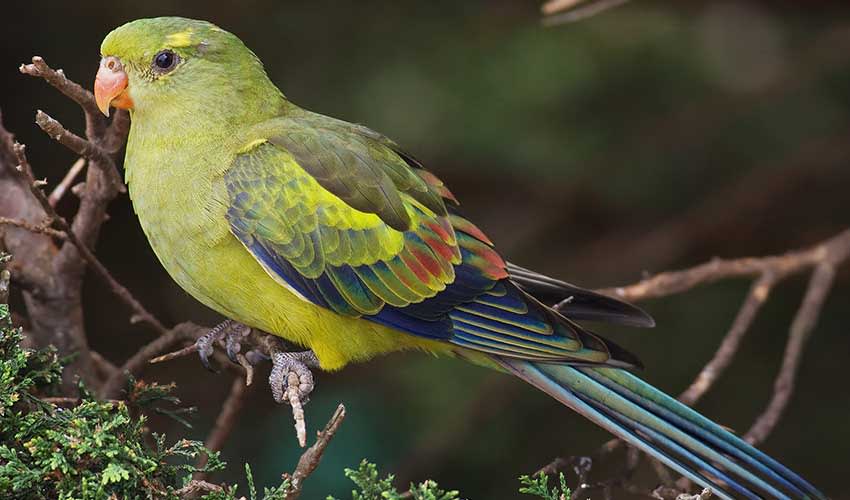
One of Australia’s most elegant and visually striking parrots, admired for its graceful shape and soft yet vivid coloring. Also known as the rock pebbler, this bird belongs to the long-tailed parrots and is instantly recognizable by its bright yellow head and chest, which contrast beautifully with its green back and wings. Hints of blue along the wings and darker tail feathers add to its refined appearance. Slender and streamlined, the regent parrot has a long tail that gives it a balanced, almost flowing look when perched or in flight. Its overall appearance feels calm and polished rather than bold or noisy.
Regent parrots are native to southern Australia and are typically found in open woodlands, mallee scrub, and areas along rivers and cliffs. They prefer landscapes with scattered trees and open spaces, which allow them to fly easily and forage efficiently. These parrots feed mainly on seeds, grains, fruits, and blossoms, often foraging quietly on the ground or in low vegetation. Their movements are deliberate and calm, and they are less frantic than many other parrots when feeding. Water sources are important to them, and they are often seen near rivers or waterholes, especially during warmer months.
Socially, regent parrots are gentle and reserved birds. They are usually seen in pairs or small family groups, though larger flocks may gather when food is abundant. Their calls are soft and musical, making them less noticeable than louder parrots even when they are nearby. Mated pairs form strong bonds and often stay together for long periods. During the breeding season, they nest in tree hollows or sometimes in crevices along rocky cliffs, which provides extra protection.
Distribution
 Australia
 Official estimate
Anything we've missed?
Help us improve this page by suggesting edits. Glory never dies!
Suggest an editGet to know me
Terrestrial / Aquatic
Altricial / Precocial
Polygamous / Monogamous
Dimorphic (size) / Monomorphic
Active: Diurnal / Nocturnal
Social behavior: Solitary / Pack / Flock
Diet: Carnivore / Granivore / Omnivore / Piscivorous / Insectivore
Migratory: Yes / No
Domesticated: Yes / No
Dangerous: Yes / No




