


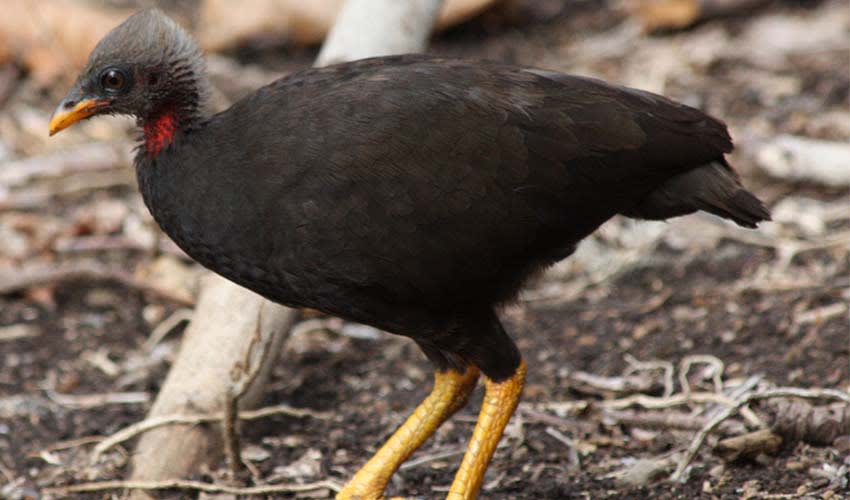
At a glance, it may look like a plain, dark, chicken-like bird with sturdy legs and a cautious expression, but its behavior is anything but ordinary. The Micronesian megapode spends much of its time on the ground, walking and scratching through leaf litter in search of food. It eats a mix of seeds, fallen fruits, insects, and other small forest finds, turning every step into a careful search for something edible.
What makes this bird famous is how it reproduces. Most birds keep their eggs warm by sitting on them, but the Micronesian megapode uses ambient heat instead. Rather than building a typical nest, it buries its eggs in warm sand or soil, often in places where the sun heats the ground or where natural warmth rises from below. In some areas, eggs are placed in sun-baked beaches; in others, they may be buried in warm earth in forest clearings. The parents’ job is not to brood the eggs but to choose a good spot and manage it—digging, covering, and sometimes adjusting the nesting site so the eggs stay at the right depth and temperature.
The Micronesian megapode is also notable for its alert, wary personality. It tends to be secretive, slipping through vegetation and staying close to cover. When threatened, it may freeze and rely on camouflage, or dash away on foot rather than taking to the air. Its feet are powerful, built for digging nesting pits and foraging through leaves, which gives it a hardworking, determined look as it scratches and shuffles along the ground. Because it depends on island habitats, it is closely tied to the health of coastal forests and undisturbed nesting sites. Beaches and warm soils are not just scenery for this bird—they are essential parts of its nursery.
Distribution
 Guam
Guam Official estimate
 Nort. Mariana Is.
 Palau
PalauAnything we've missed?
Help us improve this page by suggesting edits. Glory never dies!
Suggest an editGet to know me
Terrestrial / Aquatic
Altricial / Precocial
Polygamous / Monogamous
Dimorphic (size) / Monomorphic
Active: Diurnal / Nocturnal
Social behavior: Solitary / Pack / Herd
Diet: Carnivore / Herbivore / Omnivore / Piscivorous / Insectivore
Migratory: Yes / No
Domesticated: Yes / No
Dangerous: Yes / No




