


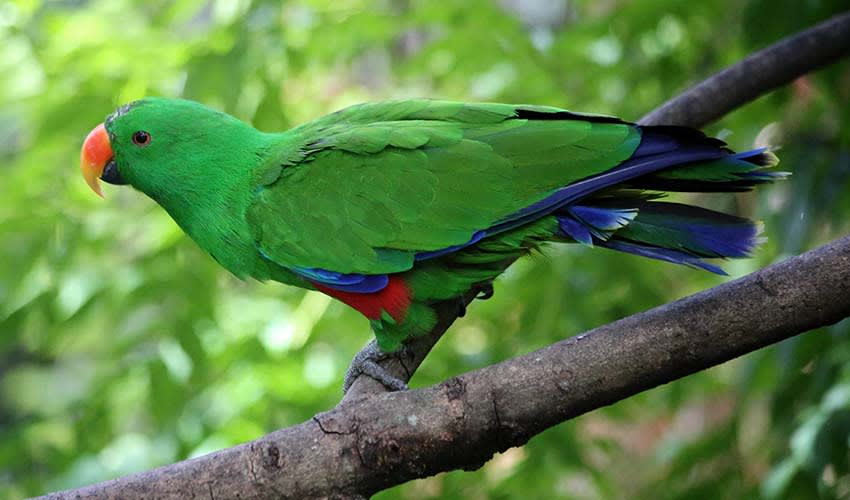
One of the most dazzling and charismatic parrots in the world, native to the Maluku Islands (or Moluccas) in eastern Indonesia. Known for its breathtaking colors and calm, intelligent nature, this bird is a living jewel of the rainforest canopy. The Moluccan eclectus belongs to the larger Eclectus species complex, which ranges across northern Australia, New Guinea, and nearby islands, but the Moluccan subspecies is especially famous for its vivid plumage and distinct island charm. Its beauty is so striking that even casual observers often mistake the males and females for entirely different species.
One of the most remarkable features of the Moluccan eclectus is its extreme sexual dimorphism, meaning that males and females look completely different. Males are a brilliant emerald green, with bright orange beaks and splashes of red and blue under their wings. Their feathers shimmer like polished jade in sunlight, blending perfectly into the leafy canopy. Females, by contrast, are a striking scarlet red with deep blue or purple underbellies and jet-black beaks. Their plumage is so vivid that they stand out like tropical flowers among the trees. For a long time, early naturalists believed these color forms were two separate species until they discovered they were mates. This extraordinary difference in appearance isn’t just for show—it’s thought to serve a purpose. The female’s red coloration helps her remain visible to potential mates near the nest cavity, while the male’s green plumage provides camouflage as he forages for food in the forest.
The Moluccan eclectus is a highly intelligent and social parrot, known for its calm temperament and gentle curiosity. In the wild, it inhabits rainforests, forest edges, and coastal woodlands, often nesting high in tree hollows. These birds feed primarily on fruits, nuts, flowers, seeds, and nectar, using their strong, curved beaks to peel open tough shells and extract pulp.
Distribution
 Indonesia
 Official estimate
Anything we've missed?
Help us improve this page by suggesting edits. Glory never dies!
Suggest an editGet to know me
Terrestrial / Aquatic
Altricial / Precocial
Polygamous / Monogamous
Dimorphic (size) / Monomorphic
Active: Diurnal / Nocturnal
Social behavior: Solitary / Pack / Herd
Diet: Carnivore / Frugivore / Omnivore / Piscivorous / Insectivore
Migratory: Yes / No
Domesticated: Yes / No
Dangerous: Yes / No




