


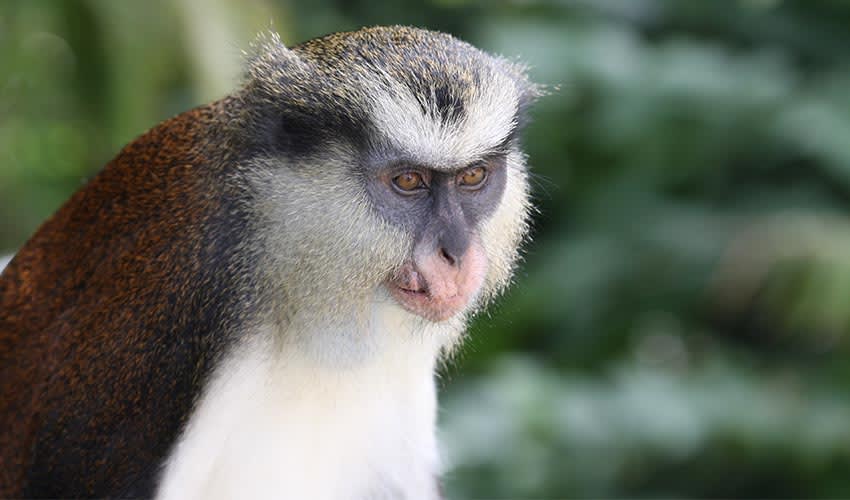
One of West Africa’s most charming and recognizable guenons, known for its bold facial markings, lively behavior, and remarkable adaptability. It is widely distributed across forests in Ghana, Togo, Benin, Nigeria, and parts of Cameroon, where it inhabits dense rainforests, forest edges, and occasionally farms or village outskirts. Mona monkeys are highly arboreal, spending most of their lives high in the canopy, where their agility and expressive communication allow them to thrive in crowded and complex forest environments.
The Mona monkey is a beautifully patterned primate with a mix of warm browns, blacks, and creamy whites. Its most defining feature is the white oval patch on its nose, giving it a bright, “masked” expression that stands out among the darker fur of its face. This is paired with white cheek patches, a white belly, and a contrasting black forehead and muzzle. Its long, slender limbs and exceptionally long tail—often longer than its body—make it a highly skilled climber.
Like other guenons, the Mona monkey is a flexible omnivore, though it has a strong preference for fruit. It also eats seeds, flowers, young leaves, and insects. Its cheek pouches allow it to store food while it searches for safer places to eat, a useful adaptation in forests full of predators. With its diet centered around fruit, the Mona monkey plays a valuable ecological role as a seed disperser, helping regenerate forests by spreading seeds throughout the canopy and understory.
One of the remarkable traits of the Mona monkey is its participation in mixed-species monkey groups. It often travels and forages alongside Diana monkeys, Lowe’s mona monkeys, and spot-nosed guenons. These associations offer several advantages, including increased vigilance against predators such as crowned eagles, leopards, and large snakes. With more eyes and ears in the canopy, all species benefit from early detection of threats.
Distribution
 Benin
Benin Cameroon
 Ghana
Ghana Grenada
 Nigeria
 São Tomé & Príncipe
 Togo
TogoAnything we've missed?
Help us improve this page by suggesting edits. Glory never dies!
Suggest an editGet to know me
Terrestrial / Aquatic
Altricial / Precocial
Polygamous / Monogamous
Dimorphic (size) / Monomorphic
Active: Diurnal / Nocturnal
Social behavior: Solitary / Pack / Herd
Diet: Carnivore / Herbivore / Omnivore / Piscivorous / Insectivore
Migratory: Yes / No
Domesticated: Yes / No
Dangerous: Yes / No




