


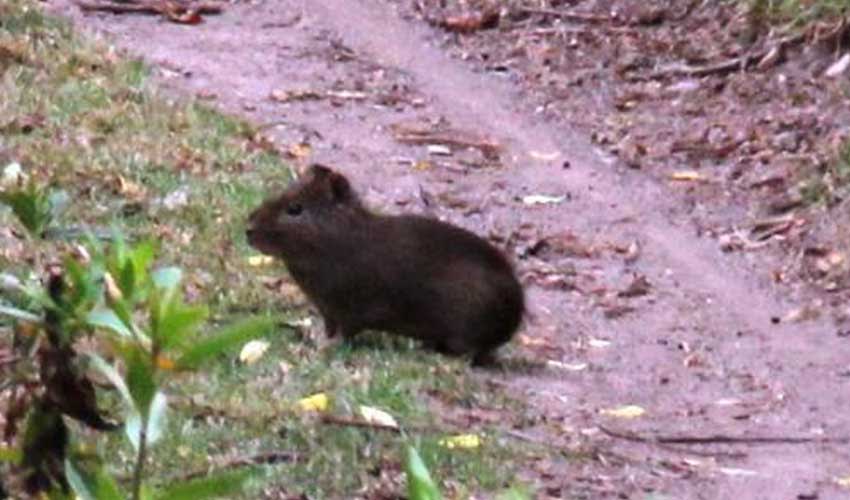
Found in the highlands of Peru, Bolivia, and parts of northern Chile and Argentina, this species inhabits a rugged world of grasslands, rocky slopes, and Andean valleys. With its compact body, short legs, and smooth brownish-gray coat, the Montane guinea pig may not be as colorful as its domestic descendants, but it is perfectly adapted to its mountain environment. Its coloration helps it blend into dry grasses and stones, keeping it hidden from predators in open landscapes where cover can be scarce.
The Montane guinea pig is the wild ancestor of the domesticated guinea pig, which has been raised for thousands of years by Indigenous cultures of the Andes. While domestic guinea pigs are rounder, calmer, and more varied in color, the Montane guinea pig is sleeker, faster, and much more alert. It lives in small groups or loose colonies, often sheltering in crevices, dense vegetation, or burrows made by other animals. Because it inhabits high-altitude regions, it must cope with rapid temperature changes, thin air, and strong sunlight—conditions that have shaped its behavior and physiology in subtle ways. Its thick fur offers protection from chilly mountain nights, while its agility helps it escape predators like foxes, hawks, and mustelids.
Like all members of the genus Cavia, the Montane guinea pig is an herbivore that feeds mainly on grasses, leaves, flowers, and tender shoots. Its strong, continually growing teeth allow it to chew tough mountain plants without wearing them down. The species is active mostly during the morning and late afternoon, avoiding the harsh midday heat and reducing the risk of being spotted by predators. Much of its daily life involves foraging in groups, staying alert for danger, and communicating with high-pitched whistles and soft chirps that help maintain social bonds within the colony.
Distribution
 Argentina
 Bolivia
 Chile
Chile Peru
PeruAnything we've missed?
Help us improve this page by suggesting edits. Glory never dies!
Suggest an editGet to know me
Terrestrial / Aquatic
Altricial / Precocial
Polygamous / Monogamous
Dimorphic (size) / Monomorphic
Active: Diurnal / Nocturnal
Social behavior: Solitary / Pack / Herd
Diet: Carnivore / Herbivore / Omnivore / Piscivorous / Insectivore
Migratory: Yes / No
Domesticated: Yes / No
Dangerous: Yes / No




