


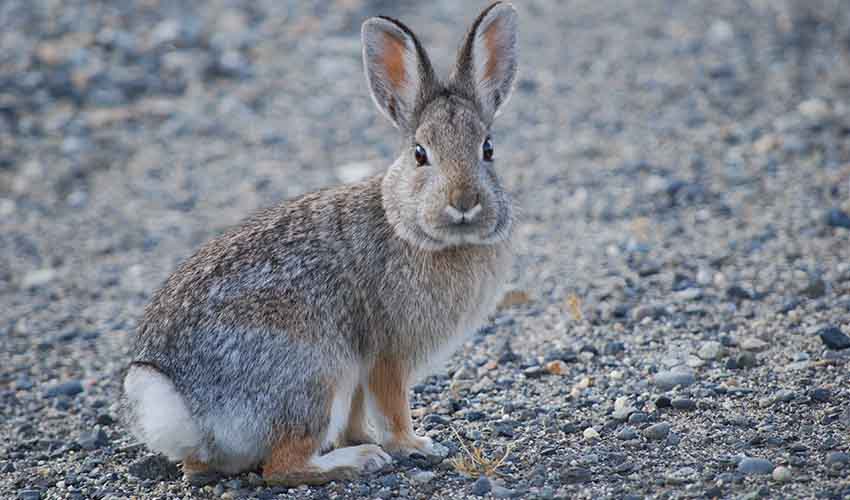
A compact, high-country rabbit built for cool slopes, brushy clearings, and the patchwork of shrubs and grasses that cover western mountains. It looks like a classic cottontail—rounded body, short neck, big eyes, and a white “cotton” tail that flashes when it runs—but it often appears a little more rugged and subtly colored than a backyard rabbit. Its coat is usually gray-brown with fine speckling that matches sagebrush, pine needles, and rocky soil, and the belly is paler. The ears are upright and fairly moderate in length, not oversized like a jackrabbit’s, and the face can show a slightly grayer, frosty tone that suits cooler habitats.
What distinguishes the mountain cottontail from other common cottontails is its strong preference for higher, drier, more mountainous terrain and the way it uses rocky, brushy cover as its main defense. Where the Eastern cottontail thrives in lawns, hedges, and suburban edges, the mountain cottontail is more at home in places like sagebrush flats near foothills, open pine and juniper woodland, mountain meadows, and brush-choked drainages. It often shares parts of its range with other rabbits, but it tends to be the one you’re more likely to meet on a cool morning hike rather than beside a city park. It also relies less on long open runs than a hare would; its survival plan is to keep cover close, memorize short escape routes, and vanish into shrubs, rock piles, or fallen logs before a predator can lock on.
Unlike many people’s idea of rabbits living in burrows, mountain cottontails often rest in shallow forms under shrubs, or they may use existing holes and rocky crevices as emergency shelter rather than digging elaborate tunnels themselves. When startled, they bolt in a short sprint to the nearest cover, often zigzagging, then stop abruptly and freeze, trusting their speckled coat to blend into the mess of branches and shadows.
Distribution
 Canada
 United States
Anything we've missed?
Help us improve this page by suggesting edits. Glory never dies!
Suggest an editGet to know me
Terrestrial / Aquatic
Altricial / Precocial
Polygamous / Monogamous
Dimorphic (size) / Monomorphic
Active: Diurnal / Nocturnal
Social behavior: Solitary / Pack / Herd
Diet: Carnivore / Herbivore / Omnivore / Piscivorous / Insectivore
Migratory: Yes / No
Domesticated: Yes / No
Dangerous: Yes / No




