


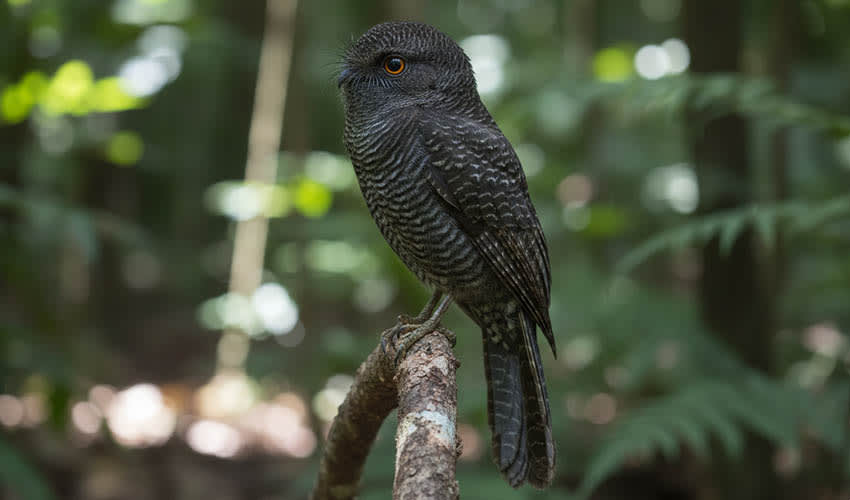
It’s known from just two old museum specimens and a tiny handful of possible sightings, yet even those traces reveal a very distinctive creature. It’s a large owlet-nightjar, noticeably bigger than the Australian Owlet-nightjar and second in size only to the extinct New Zealand species. Its plumage is a mix of grey-brown and black with fine wavy markings, giving it a mossy, bark-like look that would blend beautifully into a dark forest trunk. It has a long, slightly rounded tail, short, rounded wings, and unusually long, sturdy legs for its family—features that hint it may spend more time on or near the ground than its relatives.
This bird lives—or once lived—nowhere but New Caledonia, an island group in the southwest Pacific. Current information suggests it is (or was) tied to Melaleuca savanna and humid forest, especially very remote mountain forest blocks such as the Ni-Kouakoué massif on the main island, Grande Terre. Like other owlet-nightjars, it almost certainly nests in tree hollows and hunts at night, sitting quietly on a perch and then darting out to snatch insects from the air or off the ground. No one has ever recorded its voice; scientists guess it may give churring or whistling calls like its cousins, but for this species, that’s still only an educated guess.
The history of its discovery reads almost like a ghost story. The first specimen was collected in 1880 after a bird flew into a bedroom in the village of Tonghoué; that skin eventually ended up in the Liverpool Museum. A second specimen from 1915 was only recognized much later in an Italian collection. After that, the bird seemed to vanish. There were scattered, unconfirmed reports in the mid-1900s, but nothing solid until 1998, when two ornithologists on an expedition in the Rivière Ni valley saw a large nightjar-like bird at dusk, hawking insects over a track before disappearing back into the dark.
Distribution
 New Caledonia
 Official estimate
Anything we've missed?
Help us improve this page by suggesting edits. Glory never dies!
Suggest an editGet to know me
Terrestrial / Aquatic
Altricial / Precocial
Polygamous / Monogamous
Dimorphic (size) / Monomorphic
Active: Diurnal / Nocturnal
Social behavior: Solitary / Pack / Herd
Diet: Carnivore / Herbivore / Omnivore / Piscivorous / Insectivore
Migratory: Yes / No
Domesticated: Yes / No
Dangerous: Yes / No




