


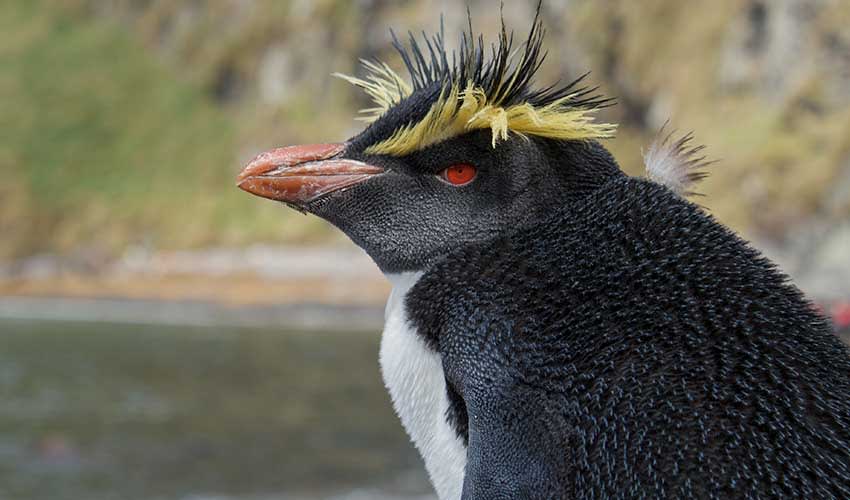
The wild-haired punk of the penguin world, instantly recognisable by the long, pale yellow eyebrow crests that flare out like messy bangs over its bright red eyes. When it stands upright on pink webbed feet and glares from under those spiky plumes, it looks both fierce and slightly comical. Like other rockhoppers, it’s built for scrambling over rough ground: strong legs, long claws, and a habit of moving in energetic hops and short, determined waddles across boulders and tussock slopes.
Unlike the more widespread southern rockhopper penguins, Northern rockhoppers have a very restricted range. They breed almost entirely on a handful of remote islands in the South Atlantic and southern Indian Oceans: mainly Gough Island and the Tristan da Cunha group in the Atlantic, and Amsterdam and St Paul Islands in the Indian Ocean. Here they form dense colonies on steep, grassy or rocky slopes close to the sea, often reached by narrow, well-worn penguin paths.
At sea, Northern rockhoppers are agile pursuit divers, using their flippers to “fly” underwater and chasing prey down to depths of at least 100 metres (328 feet), with dives that can last more than two minutes. Their foraging trips often take them far from their breeding islands into sub-Antarctic and temperate waters where cold, nutrient-rich currents concentrate krill and small cephalopods. When they return to land, they gather in noisy groups at traditional landing spots, then hop and scramble inland along familiar routes, sometimes pausing to preen those dramatic crests or engage in social displays—head-shaking, braying calls, and mutual preening between mates. Their colonies can be raucous places, full of barking calls and the shuffling of thousands of birds moving to and from the sea.
Distribution
 Falkland Islands
 French Southern T.
 New Zealand
 Saint Helena
 South Africa
Anything we've missed?
Help us improve this page by suggesting edits. Glory never dies!
Suggest an editGet to know me
Terrestrial / Aquatic
Altricial / Precocial
Polygamous / Monogamous
Dimorphic (size) / Monomorphic
Active: Diurnal / Nocturnal
Social behavior: Solitary / Pack / Colony
Diet: Carnivore / Herbivore / Omnivore / Piscivorous / Insectivore
Migratory: Yes / No
Domesticated: Yes / No
Dangerous: Yes / No




