


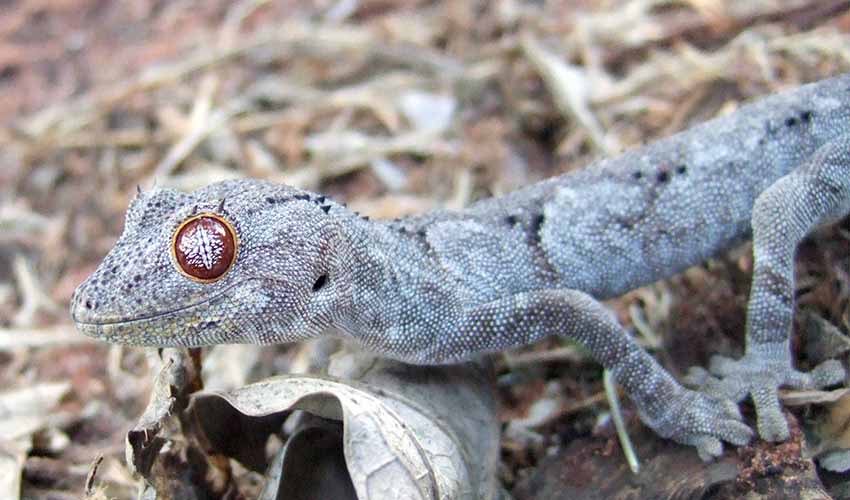
A small but fascinating reptile uniquely adapted to Australia’s arid interior. Endemic to the continent, this gecko has carved out a niche in shrublands and spinifex grass habitats stretching from the Northern Territory and Western Australia into parts of South Australia and western Queensland. It’s a modest-sized gecko—females may reach a snout-to-vent length of around 8.9 cm—with a body designed for life among tough grasses and low shrubs.
What makes the Northern spiny-tailed gecko especially interesting are the spines lining its tail and the little “eyelash”-like tubercles above its eyes. These give it a distinctive silhouette among the vegetation—its tail is armed with small, raised bumps that provide texture and maybe even a bit of protection or anchoring. Its colouration can vary considerably: from uniform greys through mottled mixes of brown, orange and white, depending on the local substrate and vegetation, making each individual a little different. The name “ciliaris” (meaning “eyelashed”) reflects those spiny eyebrow scales that are so noticeable in close-up views.
In terms of behaviour, this gecko is primarily nocturnal, but you may also spot it basking or resting by day among broom-like spinifex clusters or low shrubs. It hunts insects and other arthropods, occasionally licking sap from wattle trees when available. During the night it moves through branches and grasses, using its alert eyes and long tail to balance and manoeuvre. One remarkable adaptation of this and its close relatives is the ability to eject a sticky, odorous fluid from glands at the base of the tail when threatened. Instead of fleeing immediately, the gecko may turn its body, lift its tail, and aim a defensive spray: this unique strategy allows it to remain hidden or anchored in vegetation while deterring predators.
Distribution
 Australia
Anything we've missed?
Help us improve this page by suggesting edits. Glory never dies!
Suggest an editGet to know me
Terrestrial / Aquatic
Altricial / Precocial
Polygamous / Monogamous
Dimorphic (size) / Monomorphic
Active: Diurnal / Nocturnal
Social behavior: Solitary / Pack / Herd
Diet: Carnivore / Herbivore / Omnivore / Piscivorous / Insectivore
Migratory: Yes / No
Domesticated: Yes / No
Dangerous: Yes / No




