


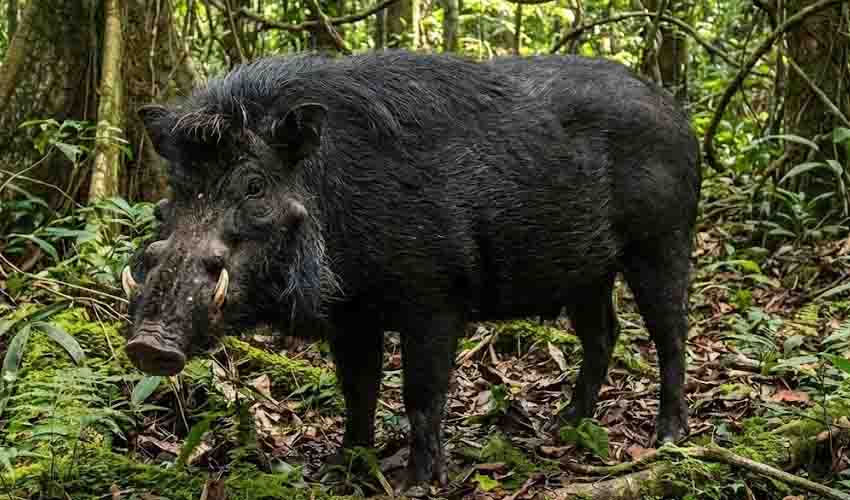
A wild pig with a tough, slightly “punk” look that fits its rugged home. It’s usually smaller and more lightly built than many people expect from a pig, with long legs for weaving through forest trails and grassland patches. The coat is typically dark—brown to blackish, with bristles that can stand up along the neck and back, especially when the animal is excited or alarmed. Adult males develop the trademark “warts”: fleshy pads on the face that act like built-in cushioning during shoving matches. They also have tusks, though not the oversized, showy kind you might imagine—more like practical tools paired with a strong jaw and a determined expression.
What really sets Oliver’s warty pig apart from its close relatives in the Philippines is its head shape and its island-only identity. It lives naturally only on Mindoro, so it’s a true local original rather than a pig you’d expect to see across the country. Compared with other Philippine warty pigs, Oliver’s warty pig is known for having a noticeably longer, more downward-pointing face, giving it a distinctive “sloped” profile. It can also show lighter hair tufts near the lower jaw that stand out against the darker coat, and the overall look tends to be more compact and “dwarf-like” than some relatives.
If the Visayan warty pig is famous for its dramatic mane and bold presence, and the wider Philippine warty pig group can look bulkier in some areas, Oliver’s warty pig often comes across as the lean, sharp-faced Mindoro specialist—built for moving quietly through a landscape that mixes forests, dry woodland, and more open stretches.
In day-to-day life, Oliver’s warty pig is a smart forager with a flexible menu. It eats roots, fallen fruit, shoots, leaves, and whatever other forest-floor snacks it can find, using its snout like a living multi-tool. Like many wild pigs, it’s alert and cautious, often choosing the cooler, quieter hours to move around
Distribution
 Philippines
Anything we've missed?
Help us improve this page by suggesting edits. Glory never dies!
Suggest an editGet to know me
Terrestrial / Aquatic
Altricial / Precocial
Polygamous / Monogamous
Dimorphic (size) / Monomorphic
Active: Diurnal / Nocturnal
Social behavior: Solitary / Pack / Herd
Diet: Carnivore / Herbivore / Omnivore / Piscivorous / Insectivore
Migratory: Yes / No
Domesticated: Yes / No
Dangerous: Yes / No




