


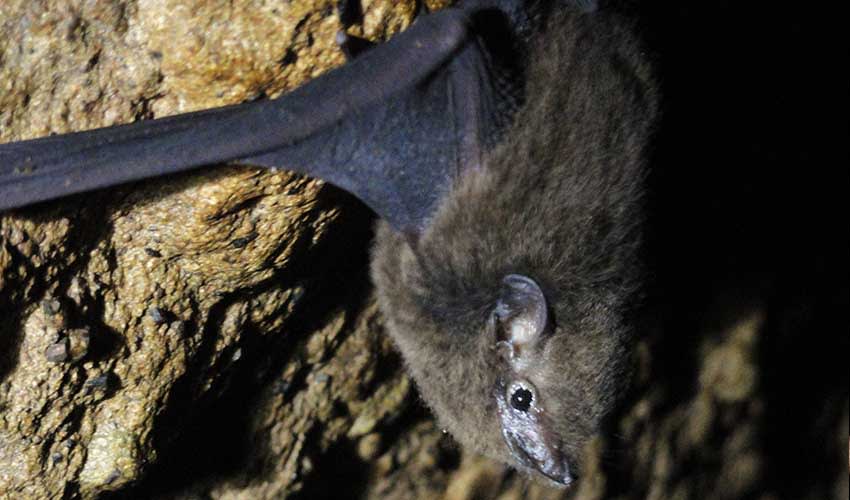
A tiny island bat with a lot of personality packed into a very small body. It weighs roughly the same as a couple of coins – yet it looks like a soft puff of chocolate-brown fur with long, narrow wings made for quick, fluttery flight. Its name comes from its tail: instead of hanging free, the tail is partly wrapped in the thin skin of the wings, like a little tail in a pocket or sheath. That “tail in a sleeve” look is one of the easiest ways to tell it apart from other bats. Up close, it has a short nose, big dark eyes, and small ears, which make it look curiously alert as it hangs upside down on cave ceilings.
For such a small animal, it has hopped across scattered Pacific islands, from places like Samoa and Tonga all the way to islands in Micronesia, crossing thousands of kilometres of open ocean over many generations. During the day, it hides in caves, lava tubes, rock cracks, and sometimes hollow trees, clinging in little groups. At sunset, the bats pour out of their hiding places like a stream of tiny shadows and head into the night to hunt. They snatch flying insects such as moths, beetles, and wasps right out of the air, using rapid flapping and quick turns. By gobbling up so many bugs, they act as natural pest control for forests and farms, even though most people on those islands never see them up close.
The Pacific sheath-tailed bat is also a very social species. It usually roosts in groups, and those groups can be anything from a handful of bats to hundreds or even thousands in a single cave. In some places, huge “bat caves” have been found where these animals pack together in enormous numbers, turning the cave into a living, rustling ceiling.
Distribution
 American Samoa
 Fiji
Fiji Guam
Guam Official estimate
 Micronesia
 Nort. Mariana Is.
 Palau
Palau Samoa
Samoa Tonga
Tonga Vanuatu
Official estimate
Vanuatu
Official estimate
Anything we've missed?
Help us improve this page by suggesting edits. Glory never dies!
Suggest an editGet to know me
Terrestrial / Aquatic
Altricial / Precocial
Polygamous / Monogamous
Dimorphic (size) / Monomorphic
Active: Diurnal / Nocturnal
Social behavior: Solitary / Pack / Colony
Diet: Carnivore / Herbivore / Omnivore / Piscivorous / Insectivore
Migratory: Yes / No
Domesticated: Yes / No
Dangerous: Yes / No




