


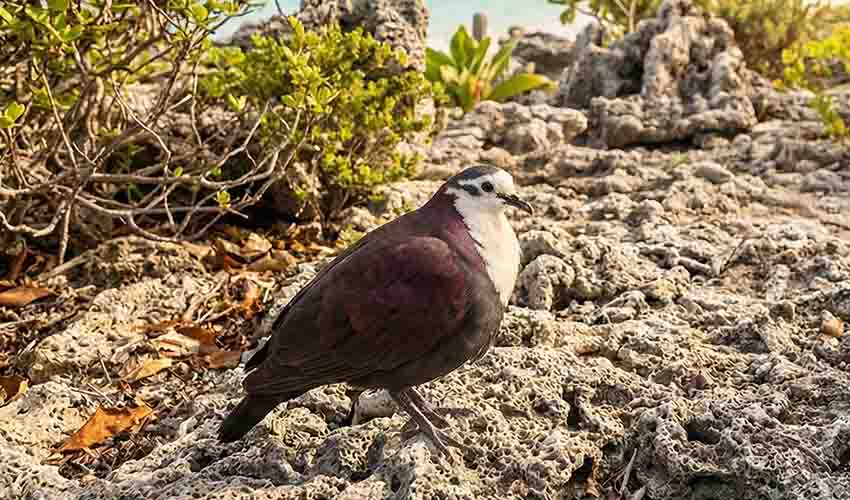
A small, secretive island dove with one of the most fragile “addresses” on Earth: tiny coral islands in French Polynesia. It’s often described as a bird that seems to vanish into its own habitat—low scrub, tangled coastal plants, and shady forest patches where it can walk quietly under cover rather than flying around in the open. Unlike the familiar city pigeons most people know, this dove is a true forest-floor specialist. It spends much of its time on the ground, stepping through leaf litter, scratching gently for food, and freezing instantly when it senses danger. That shy, low-profile lifestyle is part of its charm, but it’s also one reason the bird can be hard to spot even where it still survives.
Looks-wise, the Polynesian ground dove is surprisingly glamorous for such a quiet creature. Males can show crisp pale areas on the face and chest, with darker upperparts that may shine with purple tones on the wings when the light hits just right—more like a subtle satin sheen than a loud splash of color. Females are usually warmer, richer brown overall, which helps them blend into branches and leaf litter when nesting. Both sexes have a compact, rounded build typical of ground doves: short tail, quick wingbeats, and a “burst flight” style that gets them from one patch of cover to another fast. When they flush from the ground, they can shoot up suddenly with a sharp whir of wings, then drop back into vegetation where they become almost impossible to track with your eyes.
Historically, this species lived across more of the Society Islands and the Tuamotu archipelago, but today it survives only in a much smaller area, largely because island birds face island-sized problems. The Polynesian ground dove evolved without many mammal predators, so introduced animals—especially rats and cats—hit it like a wrecking ball.
Distribution
 French Polynesia
 Official estimate
French Polynesia
Official estimate
French PolynesiaAnything we've missed?
Help us improve this page by suggesting edits. Glory never dies!
Suggest an editGet to know me
Terrestrial / Aquatic
Altricial / Precocial
Polygamous / Monogamous
Dimorphic (size) / Monomorphic
Active: Diurnal / Nocturnal
Social behavior: Solitary / Pack / Herd
Diet: Carnivore / Herbivore / Omnivore / Piscivorous / Insectivore
Migratory: Yes / No
Domesticated: Yes / No
Dangerous: Yes / No
Distribution
French Polynesia
Official estimate
French PolynesiaDid you know?
- fact 1
- fact 2
Anything we've missed?
Help us improve this page by suggesting edits. Glory never dies!
Suggest an editGet to know me
Terrestrial / Aquatic
Altricial / Precocial
Polygamous / Monogamous
Dimorphic / Monomorphic
Active: Diurnal / Nocturnal
Social behavior: Solitary / Pack / Herd
Diet: Carnivore / Herbivore / Omnivore / Piscivorous / Insectivore
Migratory: Yes / No
Domesticated: Yes / No
Dangerous: Yes / No




