


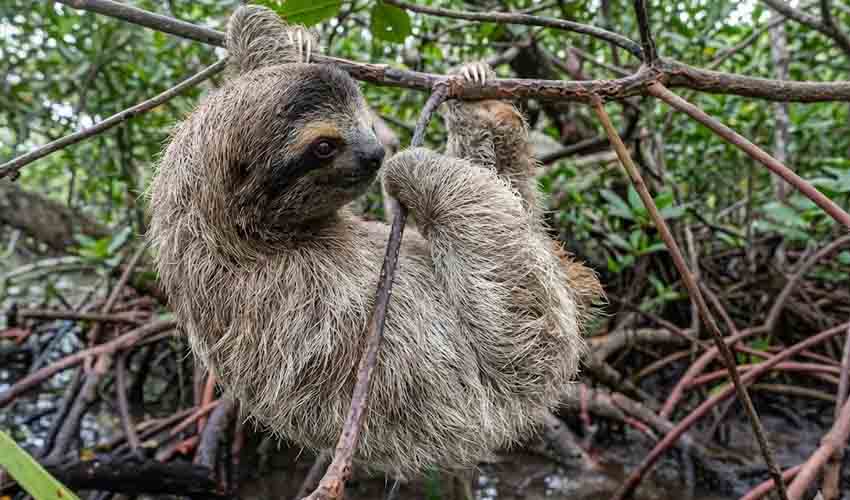
Unlike other three-toed sloths that roam broad stretches of mainland rainforest, this one is basically an island homebody. Its whole world is mangroves—gnarled trees with tangled roots that grow in salty coastal water—so it spends its life climbing, resting, and feeding in a habitat that most sloths don’t rely on. Because it’s confined to such a small area, the pygmy three-toed sloth is naturally harder to find, and that “needle-in-a-mangrove” lifestyle is a big part of what makes it so special.
As the name suggests, it’s “pygmy” compared with other three-toed sloths, typically lighter and shorter, which may be an island effect—many animals on islands evolve different sizes than their mainland relatives. It also has a slightly different look, often described as a more muted, brownish coat that blends into the shadowy mangrove canopy. Like other sloths, it has three toes on each foot, a gentle face that makes it look permanently calm, and a slow-and-steady way of moving that seems almost like it’s saving its energy for something important (even though the important thing is usually just napping). But its island setting shapes how it lives: in mangroves, the branches can be lower, twistier, and more exposed to wind and salt, so being smaller and well-camouflaged may help it cope with that unique environment.
What truly distinguishes the pygmy three-toed sloth from other three-toed sloths isn’t just its size—it’s its isolation and the way that isolation has set it apart. Other members of the three-toed sloth group are spread across mainland Central and South America and can use a variety of forest types. The pygmy three-toed sloth, on the other hand, is limited to one island and is strongly tied to mangrove forests, which is an unusual choice of home for a sloth.
Distribution
 Panama
 Official estimate
Anything we've missed?
Help us improve this page by suggesting edits. Glory never dies!
Suggest an editGet to know me
Terrestrial / Aquatic
Altricial / Precocial
Polygamous / Monogamous
Dimorphic (size) / Monomorphic
Active: Diurnal / Nocturnal
Social behavior: Solitary / Pack / Herd
Diet: Carnivore / Herbivore / Omnivore / Piscivorous / Insectivore
Migratory: Yes / No
Domesticated: Yes / No
Dangerous: Yes / No




