


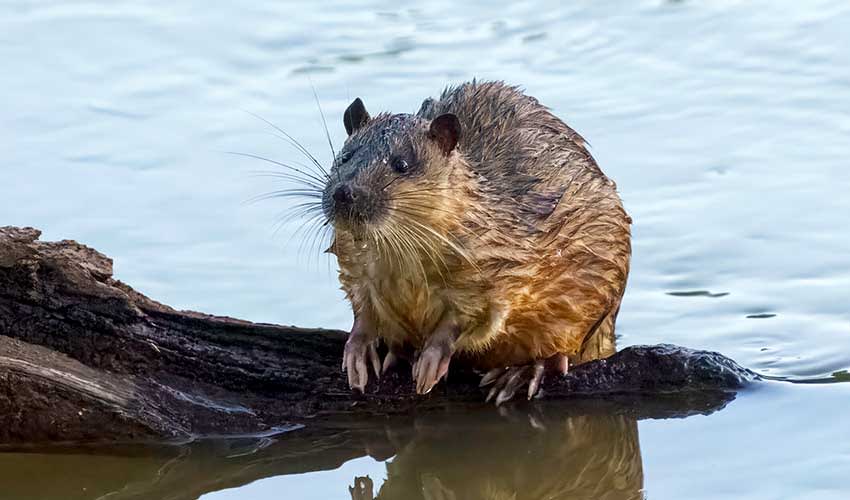
It’s found across much of Australia and parts of New Guinea, living along rivers, creeks, lakes, farm dams, wetlands, and even sheltered coastal areas. It’s a big rat by local standards, so when one swims past, it looks more like a small mink than a house mouse. Its fur is dense and waterproof, usually dark brown to black on top and creamy or golden on the underside. The tail is thick and strong, dark for most of its length but ending in a pale or white tip, as if it’s been dipped in paint. Large hind feet with partial webbing act as paddles, while smaller front paws are perfect for grabbing and holding food.
Rakali are mostly nocturnal hunters and superb swimmers. Around dusk, they leave burrows or nest chambers hidden in banks, under roots, or among rocks, then patrol the water’s edge and shallow margins. They swim low in the water with just the head and upper back showing, diving to rummage under stones and submerged logs.
Their diet is very broad: yabbies and freshwater crayfish, crabs, mussels, snails, aquatic insects, worms, frogs, fish, and sometimes even birds or small mammals if they can catch them. A classic sign of a rakali is a “dining rock” or log piled with empty mussel shells and crab pieces—like a little seafood restaurant that only opens at night. They’ll often carry food out of the water, sit up on their haunches, and use their front paws almost like hands to turn and strip their prey.
Rakali have an interesting human history too. For a long time ,they were simply called “water rats” and were sometimes trapped for their fur or treated as pests around fisheries. More recently, there’s been a push to use the name “rakali,” adapted from Indigenous Australian languages, to reflect their native status and improve their image.
Distribution
 Australia
 Indonesia
 Papua New Guinea
Anything we've missed?
Help us improve this page by suggesting edits. Glory never dies!
Suggest an editGet to know me
Terrestrial / Aquatic
Altricial / Precocial
Polygamous / Monogamous
Dimorphic (size) / Monomorphic
Active: Diurnal / Nocturnal
Social behavior: Solitary / Pack / Herd
Diet: Carnivore / Herbivore / Omnivore / Piscivorous / Insectivore
Migratory: Yes / No
Domesticated: Yes / No
Dangerous: Yes / No




