


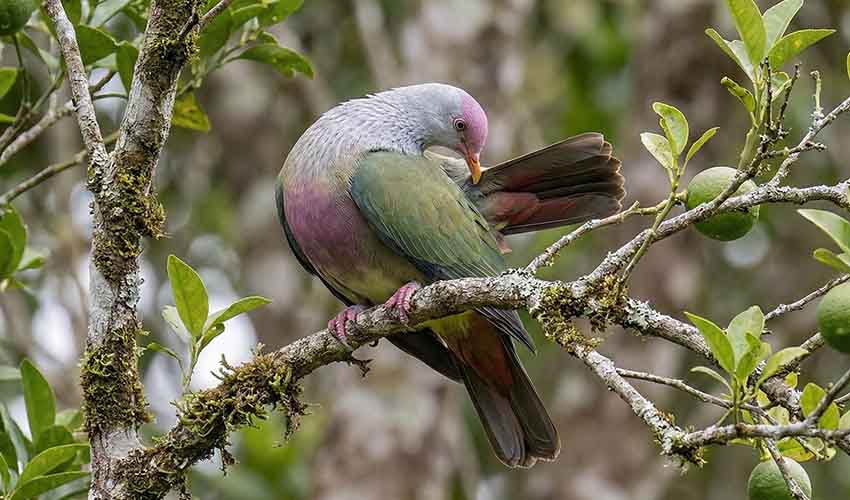
A beautifully unique island bird found nowhere in the world except Rapa Iti, a small and remote island in the Austral Islands of French Polynesia. This extreme isolation has shaped the dove’s entire story. Unlike widespread pigeons that adapt easily to many environments, the Rapa fruit dove is a true island specialist, tied closely to the forests of a single volcanic island. Because of this, it has become both a symbol of Rapa’s natural heritage and an example of the fragility of island ecosystems.
In appearance, the Rapa fruit dove is subtle rather than flashy, but quietly elegant. Its body is mostly soft grey, blending smoothly with the shaded forest canopy where it spends most of its time. The most striking feature is a deep crimson-red patch on the crown, which looks almost like a dab of paint placed carefully on the bird’s head. This splash of colour sets it apart from other fruit doves and makes it unmistakable when seen well. Like other fruit doves, it has a compact body, short tail, and rounded wings—features that suit short flights between trees rather than long journeys.
The Rapa fruit dove lives mainly in upland forest, where native trees produce the fruits it depends on for food. Fruit doves are important seed dispersers, swallowing fruit whole and later spreading seeds through the forest. In this way, the Rapa fruit dove helps maintain the health and regeneration of the island’s plant life. Because it relies on fruiting trees, it tends to stay high in the canopy, moving quietly from branch to branch. This makes it easy to overlook, even on an island where it is one of the most distinctive birds. Its calls are thought to be low and soft, fitting a lifestyle that avoids drawing attention.
Distribution
 French Polynesia
 Official estimate
Anything we've missed?
Help us improve this page by suggesting edits. Glory never dies!
Suggest an editGet to know me
Terrestrial / Aquatic
Altricial / Precocial
Polygamous / Monogamous
Dimorphic (size) / Monomorphic
Active: Diurnal / Nocturnal
Social behavior: Solitary / Pack / Herd
Diet: Carnivore / Frugivore / Omnivore / Piscivorous / Insectivore
Migratory: Yes / No
Domesticated: Yes / No
Dangerous: Yes / No




