


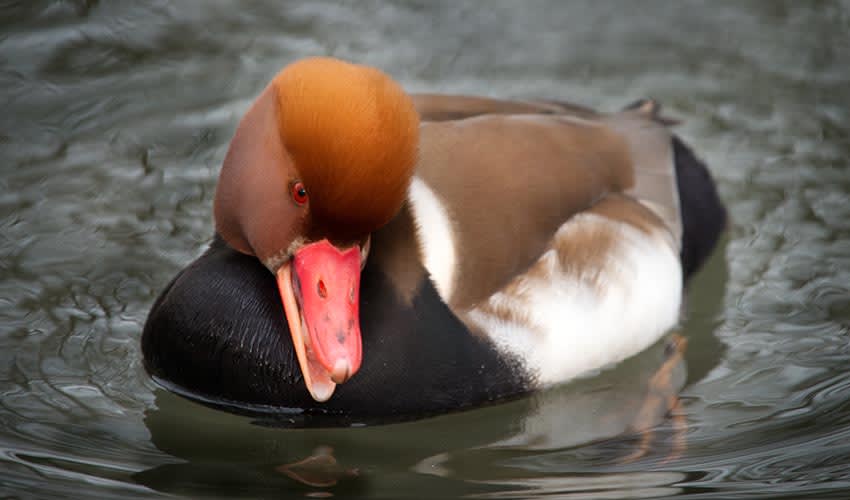
One of those ducks you can’t really confuse with anything else—at least not if it’s a fully dressed adult male. He looks like he’s wearing a bright orange crash helmet, with a rounded, puffed-up head that glows in the sun. Add a rich black chest, soft pale flanks, a warm brown back, and a bright red bill and eyes, and you get a bird that looks more like a floating toy than something wild. Females are much more subtle but still elegant: soft brown overall with a pale face and darker cap, and a greyish bill with a hint of red.
The red-crested pochard lives mainly around lakes, reservoirs, and large, quiet wetlands across parts of Europe and Asia. It likes fairly deep water with plenty of open space for swimming and diving, but also values a ring of reeds and aquatic plants around the edges. These ducks are technically “divers,” but they’re not strict deep-water specialists. They’re perfectly happy to tip up like dabbling ducks in shallow water, tails in the air, feeding at the surface. Their favorite foods are seeds, roots, and leafy parts of aquatic plants, along with a side of insects, snails, and other small creatures. In some places, they feed a lot at night, cruising out into open water after dark and then spending much of the day resting in quieter corners of the lake.
Red-crested pochards tend to nest in loose groups, often near other waterbirds, on lakes with plenty of cover. The female chooses a well-hidden spot among reeds, low bushes, or floating vegetation and builds a nest lined with soft down plucked from her own body. She lays a clutch of eggs and then does most of the work herself: incubating, guarding, and later leading the ducklings. The male often stays nearby at first but eventually leaves to join other males for the molt, when they temporarily lose their ability to fly and gather on safe stretches of open water
Distribution
 Afghanistan
 Albania
 Algeria
 Armenia
 Austria
 Azerbaijan
 Bahrain
 Bangladesh
 Belarus
 Belgium
 Bhutan
 Bosnia And Herz.
 Bulgaria
 China
China Croatia
 Cyprus
 Czechia
 Denmark
 Egypt
Egypt Estonia
 Finland
 France
 Georgia
 Germany
 Greece
 Hungary
 India
India Iran
Iran Iraq
Iraq Ireland
 Israel
 Italy
Italy Japan
Japan Jordan
 Kazakhstan
 Kyrgyzstan
 Latvia
 Lebanon
 Libya
Libya Malta
Malta Moldova
 Mongolia
 Montenegro
 Morocco
 Myanmar
 Nepal
Nepal Netherlands
 North Macedonia
 Norway
 Oman
Oman Pakistan
 Poland
 Portugal
 Qatar
Qatar Romania
 Russia
 Saudi Arabia
 Serbia
 Slovakia
 Slovenia
 Spain
Spain Sri Lanka
 Sweden
 Switzerland
 Syria
Syria Tajikistan
 Thailand
 Tunisia
 Turkmenistan
 Turkey
 UAE
UAE Ukraine
 United Kingdom
 Uzbekistan
Anything we've missed?
Help us improve this page by suggesting edits. Glory never dies!
Suggest an editGet to know me
Terrestrial / Aquatic
Altricial / Precocial
Polygamous / Monogamous
Dimorphic (size) / Monomorphic
Active: Diurnal / Nocturnal
Social behavior: Solitary / Pack / Flock
Diet: Carnivore / Herbivore / Omnivore / Piscivorous / Insectivore
Migratory: Yes / No
Domesticated: Yes / No
Dangerous: Yes / No




